
Corporate Concierge Security Melbourne: 2026 Risk Guide
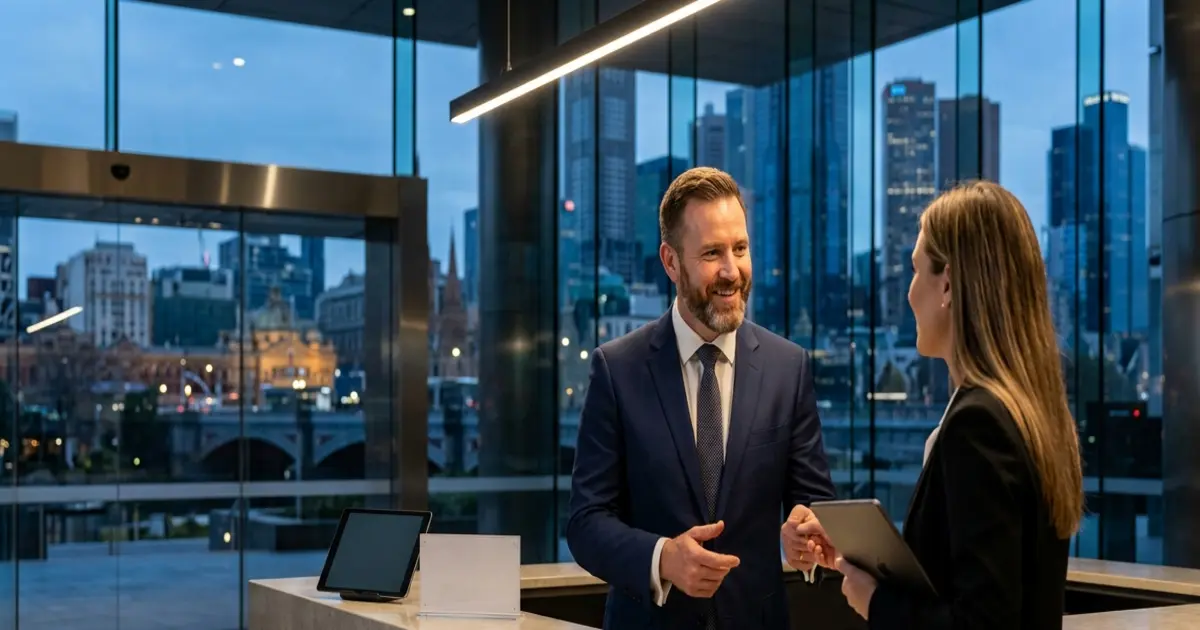
Corporate Concierge Security Melbourne used to mean one thing: a bloke in a blazer near the lifts, nodding good morning at whoever came through. That’s not the job anymore, and hasn’t been for a while. Spend twenty minutes in the lobby of any decent tower on Collins Street, or one of the newer builds out in Docklands, and you’ll notice the person at the desk is doing a lot more than saying hello. Visitor checks, access control, contractor sign-offs, incident notes — sometimes all four inside the same ten minutes. Same blazer. Different job.
It matters because the front desk is usually where risk shows up first. Not in a board meeting. Not in an IT alert. At the desk, when a delivery driver walks in behind someone with a swipe card, or a contractor turns up without the paperwork that was supposed to be emailed through Tuesday. Miss that layer and the rest of the building’s security — the access system, the cameras, the insurance policy — ends up quietly covering for a gap that never needed to exist in the first place.
Why Corporate Concierge Security Melbourne Stopped Being Just Reception
For years property managers ran concierge and security as two separate budget lines. One was hospitality. The other was risk. That split doesn’t really hold up anymore, and most commercial risk management Victoria frameworks now treat the two as one function, because in practice they are.
Here’s the logic, and it’s not complicated. Every person entering a commercial building passes the concierge desk before they reach anything else — before the tenant’s own reception, before the lift lobby, before an office door with a lock on it. If that first checkpoint is staffed by someone with no security training, the building is effectively relying on cameras and swipe cards to catch whatever the desk missed. That’s the wrong order of operations. The desk should be the first line, not the backup plan.
We went into this in more depth in our corporate security assessment guide for 2026, which covers how Melbourne office risk profiles have shifted since 2024. Short version: tenants expect more, insurers ask harder questions at renewal time, and a receptionist with a half-day security induction doesn’t cut it for either anymore.
What Front of House Security Melbourne Buildings Should Actually Look Like
There’s a real gap between someone who’s had a quick security briefing and a properly trained concierge guard, and it shows up in moments most tenants never clock — until the one time it goes wrong.
A well-trained operator working to a front of house security Melbourne standard will typically:
- Confirm visitor identity and purpose before handing over a pass, not after they’re already in the lift
- Spot a tailgating attempt at the lift lobby and step in without turning it into a scene
- Know which contractors are pre-cleared for the day, and which ones need a phone call upstairs first
- Log incidents properly, in a form someone can actually use later, rather than a note scrawled in a desk diary
- Keep the whole thing feeling smooth for tenants and visitors, even while all of the above is happening
That last one gets underrated constantly. Good front-of-house security is meant to be invisible. The second a visitor actually notices they’re being checked, something in the delivery has gone slightly wrong.
Client Experience and Risk Control Aren’t Fighting Each Other
There’s a stubborn idea in commercial property that tighter security automatically makes a building feel colder. We’d push back on that. Nothing kills client experience faster than a visitor standing at an empty desk for four minutes because nobody’s around, or a courier wandering the lobby unchallenged because no one flagged them at the door.
Done properly, risk control is invisible to the people it’s protecting. A concierge who greets a visiting client by name, has the pass sitting ready, and walks them to the lift is running client experience and risk control at the same time, inside the same sixty seconds. That’s the job now. Not choosing between hospitality and vigilance — running both without either one slipping.
The buildings that get this right tend to share a few habits. Concierge staff who actually know the tenant list, not just a laminated sheet behind the desk. A visitor management system that’s used consistently, including during the 8:45am rush when it’s tempting to wave people through. And a clear line for what happens when something looks slightly off — because “slightly off” is usually how these things start.
What Concierge Security Guards Are Actually Trained To Do
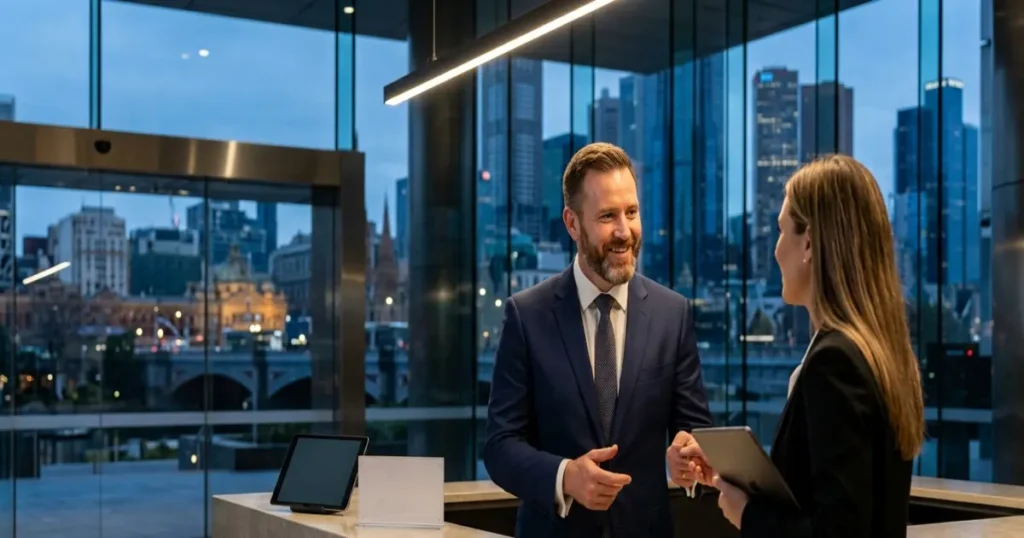
A lot of Melbourne businesses assume concierge and static guard roles are basically the same thing with a nicer uniform. They’re related, but concierge carries an extra layer — the guard is representing the building and every tenant in it, to everyone who walks through that door, all day.
Our corporate security teams, along with the security guards Melbourne crews we place in front-of-house roles, are trained across a handful of areas that matter most:
- Access control discipline — confirming who’s meant to be there, every time, not just when someone looks unfamiliar
- De-escalation — most front-desk incidents get resolved with a calm word, not a confrontation
- Documentation — every incident, even a minor one, gets logged so patterns can be picked up over weeks
- Emergency procedure — evacuation coordination and liaison with building management, whether it’s a drill or the real thing
- Presentation — this is still a client-facing role, and it needs to read as professional, never intimidating
The gap between a general reception hire and a licensed concierge security guard is exactly where risk tends to sit. It’s rarely one big miss. It’s a string of small ones that eventually add up to an incident nobody saw building.
A Quick Risk Control Checklist for Melbourne Office Buildings
If you manage a commercial site and haven’t looked hard at this in a while, these are worth asking before your next lease renewal or insurance review comes around:
- Is your front-of-house team licensed security staff, or hospitality hires with security duties bolted on informally?
- Does the visitor process actually get followed at 8:45am and 5:15pm, not just when things are quiet?
- Do incident logs get reviewed regularly, or do they sit in a folder until something forces someone to go looking?
- Does your concierge team know the after-hours escalation chain without needing to check a manual first?
- Has an independent commercial security services review happened in the past year?
If two or more of those get a shaky answer, it’s worth a proper walkthrough rather than waiting for the renewal date to force the conversation.
Choosing a Corporate Concierge Security Melbourne Provider
Not every provider handles concierge placements the same way. Some send whoever’s rostered that day and call it done. Others build a dedicated team for a site and keep them there, so tenants see the same faces over months rather than a rotating cast of strangers — which, for what it’s worth, is one of the better deterrents going. Familiar faces notice when something’s different a lot faster than someone working their third different building that week.
When you’re comparing providers, ask directly how they staff concierge roles, whether guards are matched long-term to a site, and how incident reports actually get back to building management. If a provider can’t answer any of that clearly, they’ve probably never thought about concierge as anything more than a shift to fill.
FoxWatch Security runs dedicated concierge and front-of-house teams across Melbourne commercial towers, matched to sites instead of rotated at random, with reporting built around what property managers actually need to see. If your current setup feels more reactive than planned, get in touch and we’ll walk your site through a proper risk review.
Frequently Asked Questions
What does corporate concierge security in Melbourne actually include?
Visitor screening, access control, incident logging, and client-facing reception, combining hospitality with trained risk control at the building’s main entry point.
Is concierge security different from a standard receptionist?
Yes. Concierge security guards hold security licensing and are trained in access control, de-escalation, and reporting, unlike a purely hospitality-focused receptionist.
How does concierge security improve client experience?
Trained concierge staff manage visitors smoothly and discreetly, so checks feel like good service instead of obstruction, protecting risk control and first impressions together.
Do Melbourne office buildings legally need licensed concierge guards?
Requirements vary by building and insurer, but licensed guards are strongly recommended for commercial risk management and are often required under insurance conditions.
How much does corporate concierge security cost in Melbourne?
Pricing depends on hours, site size, and staffing model, generally sitting within standard commercial security guard rates. Contact FoxWatch Security for a site-specific quote.
Comments are closed