
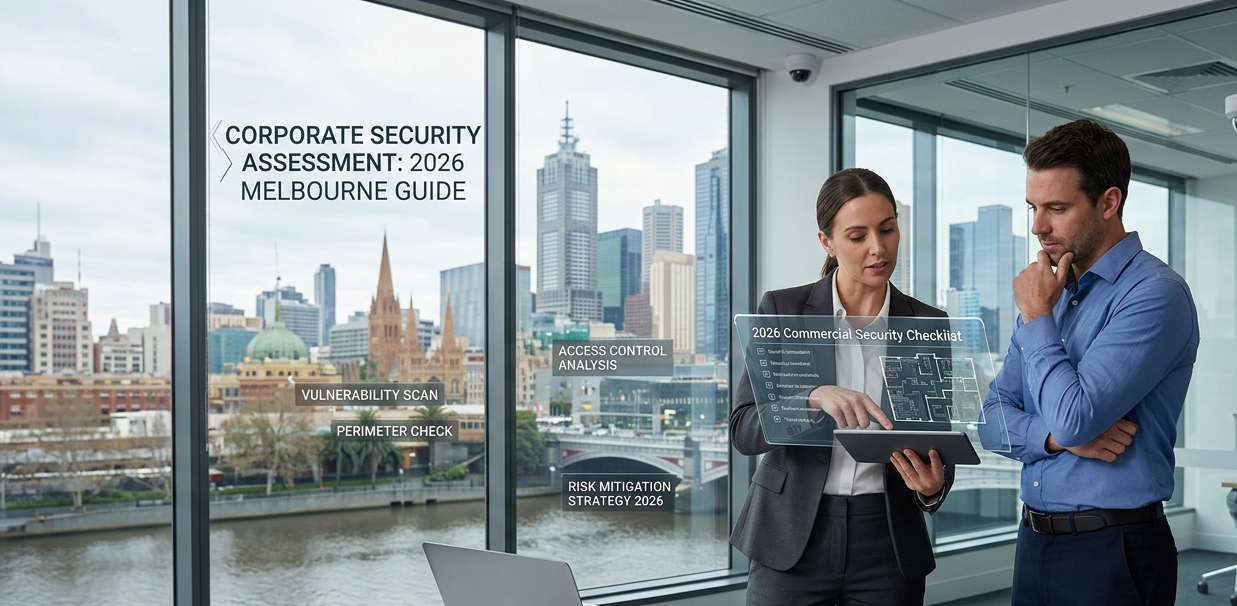
Corporate Security Assessment 2026 — if you run a business in Melbourne and haven’t done one recently, you’re not alone. Most business owners treat security the same way they treat smoke detectors: set it up once, assume it still works, and only think about it when something goes wrong.
The problem with that logic is simple. The threats facing Melbourne businesses in 2026 are not the same ones businesses were dealing with five years ago. Staff turnover has changed who has access to what. Commercial buildings have changed hands, changed tenants, changed management companies. CCTV systems that were installed in 2019 are now running on outdated firmware with blind spots nobody mapped. And across industries — from St Kilda Road law firms to Dandenong warehouses — the gap between “we’ve got security” and “our security actually works” has quietly widened.
A Corporate Security Assessment is the thing that closes that gap. Not a clipboard walkthrough. Not a form your insurance broker sends you. A real, honest look at where your business is exposed and what it would take to fix it.
This guide is written for Melbourne business owners and operations managers who want to understand what that process looks like — and get it right.
Why 2026 Is the Year Melbourne Businesses Need to Pay Attention
Let’s skip the generic statistics and talk about what’s actually shifted in Melbourne’s commercial security environment heading into 2026.
Tenancy churn has created access control problems nobody’s cleaned up.
Melbourne’s CBD vacancy rates climbed and then corrected over the past few years. That movement means buildings have cycled through multiple tenants, fitouts, and building management arrangements. Swipe cards issued to contractors three tenants ago are sometimes still active. Master key records don’t match current holders. It’s not malicious — it’s administrative drift. But it’s the kind of thing that shows up badly in a corporate security risk assessment.
The insider threat is real and underreported.
In conversations with security professionals across Melbourne, the same theme comes up: the incidents that cause the most damage — financially and reputationally — often involve people with legitimate access. An employee who knows where the server room is. A cleaner who knows which desk has the petty cash. A contractor who knows the alarm code because someone told them for convenience. A full corporate security assessment looks at internal risk, not just the front door.
Compliance requirements are getting teeth.
Melbourne businesses in financial services, healthcare, legal, and government contracting are increasingly being asked to provide documented evidence of a commercial security risk assessment — not just a verbal assurance. Clients want to see it. Regulators want to see it. And when something goes wrong without one on file, the liability conversation gets uncomfortable fast.
None of this is reason to panic. It’s reason to look clearly at where you actually stand.
Melbourne’s Security Landscape, Suburb by Suburb
One of the most common mistakes in a corporate security assessment is treating Melbourne as one homogenous environment. It’s not. The risks faced by a law firm on St Kilda Road are genuinely different from those facing a food distributor in Sunshine. Local context matters — a lot.
Melbourne CBD and Southbank
The core issue in high-rise commercial towers isn’t armed robbery — it’s access. Tailgating through lobby security, piggyback entry into lift lobbies, and opportunistic theft in common areas are the consistent problems. After-hours security in multi-tenanted towers often has gaps because building management handles the lobby, tenants handle their own floor, and nobody’s clearly responsible for the stairwells or basement car parks.
If your business is in the CBD, your physical security assessment should give serious attention to after-hours protocols, visitor management in shared lobbies, and who your building’s response procedure actually covers.
Fitzroy, Collingwood, and Richmond
These inner suburbs have seen enormous commercial growth — creative agencies, tech companies, small professional services businesses in converted warehouse spaces. The building stock is older, rear lane access is often poorly lit, and roller door security on converted industrial spaces is frequently outdated. Break-and-enter risk in this corridor is higher than the office aesthetic suggests.
St Kilda Road
Concentrated professional services — law, finance, consulting, medical. The physical security tends to be better here (card access, intercoms, decent CCTV), but the soft underbelly is process: contractor access that isn’t tracked, visitor sign-in that’s inconsistent, and sensitive documents that aren’t handled securely after hours. A commercial security risk assessment in this corridor is frequently an audit of habits as much as hardware.
Dandenong, Laverton, and the Western Industrial Precincts
Warehousing, logistics, manufacturing. The threat profile here is materially different: perimeter security, yard access, cargo integrity, vehicle management. These sites are often large enough that gaps are genuinely hard to spot without a structured walkthrough. Cargo theft in Melbourne’s western industrial corridor is an ongoing issue that doesn’t make the news but absolutely makes the insurance claims data.
Docklands and Fishermans Bend
Newer commercial precincts, which creates a false sense of security. “New building” and “secure building” are not the same thing. Integrated security systems in new commercial developments are sometimes installed to minimum spec and never properly configured. A corporate security assessment 2026 on a Docklands premises often finds more gaps than expected precisely because nobody assumed there would be any.
How to Do a Security Risk Assessment — The Real Process
Here’s what a genuine corporate security risk assessment looks like when it’s done properly, not just ticked off.
Start With Scope, and Be Honest About It
The scoping conversation is where most self-conducted assessments fall apart. Businesses try to cover everything at a surface level, produce a long document, and come away no clearer on priorities.
Pick your scope deliberately. For most Melbourne SMEs:
- Every physical entry and exit — including ones that are “never used”
- Server rooms, data storage, and anywhere sensitive information lives
- Cash handling areas and the processes around them
- Basement car parks, loading docks, and delivery areas
- The specifics of your visitor management process (not what it’s supposed to be — what it actually is day to day)
- Contractor access: who has it, how it’s granted, and whether it expires
For larger organisations or regulated industries, layer in:
- Executive protection requirements
- Emergency response procedures and whether staff actually know them
- How your security posture connects to your business continuity plans
Know What You’re Protecting Before You Decide How to Protect It
This step sounds obvious. It’s almost always skipped.
Before you assess vulnerabilities, build an honest asset inventory. In a corporate security assessment, “assets” covers more ground than most people expect:
- Your people — staff, executives, visitors, and contractors
- Physical property — equipment, vehicles, fitout, stock
- Intellectual property — contracts, client data, proprietary processes, tender documents
- Cash and negotiable instruments
- IT infrastructure — servers, workstations, network hardware
- Reputation — because a single security incident can cost more in client confidence than it does in replacement hardware
Your asset protection strategies are only as good as your understanding of what you’re actually protecting. This inventory is the foundation.
Identify Security Vulnerabilities — All of Them
This is the core of any physical security assessment. You’re looking for the gaps between what your current security measures are supposed to do and what they’d actually do if tested.
In Melbourne commercial properties, the vulnerabilities that come up most consistently include:
Lighting failures. Rear access points, car park ramps, loading dock areas, and stairwells with inadequate lighting are common. Lighting is cheap to fix and dramatically reduces opportunistic risk — yet it’s routinely overlooked.
CCTV that doesn’t actually cover what people think it covers. Cameras get moved during fitouts. Lenses drift. Newer furniture or signage creates blind spots. The camera installed to cover the server room door now covers a pot plant. Nobody noticed because nobody checked.
Access credentials that were never revoked. Staff leave. Contractors finish their work. Building management changes. The access card, the key, the alarm code — sometimes these follow people out the door because the off-boarding process didn’t include a security step.
Visitor management that runs on optimism. A paper sign-in book at reception, checked by whoever happens to be at the desk, is not a visitor management system. It’s a record that someone visited, created after they were already inside.
Alarm response gaps. An alarm that goes off and results in a 45-minute police response is not a deterrent — it’s a time limit for whoever set it off. Dedicated alarm response services change that equation.
Contractor access with no oversight. The plumber, the IT contractor, the cleaning company — how are they managed when they’re on site? Are they escorted? Do they sign in? Does anyone know which areas they accessed?
When you identify security vulnerabilities, write them down with specifics. “CCTV has gaps” is not useful. “Camera 4 on level 3 has a blind spot covering the eastern stairwell door, which is the primary after-hours exit route” is useful.
Run a Likelihood and Impact Assessment
Not every vulnerability is equally urgent. Some gaps are theoretical problems — technically present, but requiring a specific, unlikely chain of events to be exploited. Others are active risks that could materialise next week.
A simple two-axis framework works fine here:
| Low Impact | High Impact | |
| High Likelihood | Manage systematically | Fix immediately |
| Low Likelihood | Monitor periodically | Have a response plan |
Apply this grid to every vulnerability you’ve identified. It turns a list of problems into a prioritised action plan — which is what a corporate security risk assessment is supposed to produce.
Build Your Risk Mitigation Checklist
This is where the assessment turns into something actionable. A practical risk mitigation checklist for Melbourne businesses should include:
- [ ] Audit all active access credentials — cards, keys, codes — against current staff and contractor lists
- [ ] Walk every CCTV camera coverage area and document actual (not assumed) coverage
- [ ] Test all external lighting and replace or reposition where coverage is inadequate
- [ ] Review alarm response contracts and confirm current response time SLAs in writing
- [ ] Formalise visitor management — electronic systems are preferable, but a consistent manual process beats an inconsistent digital one
- [ ] Establish written contractor access protocols: sign-in, escort requirements, access time limits
- [ ] Audit cash handling procedures and verify secure storage compliance
- [ ] Conduct a staff briefing on current physical security procedures — many staff don’t know what they are
- [ ] Consider whether mobile patrol coverage is appropriate for your site’s after-hours risk profile
- [ ] Set a review date — put it in the calendar before you close the assessment document
Implement — Then Actually Review
The assessment has no value sitting in a shared drive. The gaps you’ve identified need to be closed, in priority order, with ownership assigned to a specific person.
And then — six months later, or twelve months, or whenever your environment changes materially — you do it again. Security is not a project. It’s an ongoing process.
Security Audit Checklist: The Physical Details Melbourne Businesses Miss
Beyond the broad process, here’s a focused security audit checklist for the physical elements that are most often underdone in Melbourne commercial properties:
Perimeter and Entry Points
- All perimeter doors fitted with quality deadbolts or functioning electronic access control
- After-hours entry is via monitored intercom or video intercom — not a simple keypad
- Reception is staffed during all business hours, with a documented out-of-hours protocol
- Active CCTV signage is visible at entry points (legally required in Victoria if cameras are operating)
- External lighting covers all access points with no dead zones
Internal Controls
- Server rooms, network equipment, and sensitive document storage are in separately secured areas — not just the general office
- Access to sensitive areas is role-based, not universal
- Clean desk policy is enforced in areas handling client or confidential information
- Printer and document disposal processes are specified and followed
Technology and Systems
- All CCTV cameras are operational, positioned correctly, and recording at sufficient resolution to identify individuals
- Recording is reviewed at least periodically — cameras that are recording but never checked are not providing security
- Alarm system has been tested in the last six months, not just assumed to be working
- Alarm monitoring is linked to a response service with a documented response time
After-Hours
- Mobile patrol coverage at irregular intervals — the irregularity matters; predictable patrols are easy to work around
- Current on-call contact list accessible to all senior staff
- Out-of-hours alarm response procedure is written down and known, not just assumed
People and Process
- Staff understand what tailgating is and have been briefed on how to handle it
- Visitors are signed in every time — not just when the receptionist remembers
- Contractors are tracked through a defined access process and signed out on departure
What Corporate Security Services in Melbourne Should Actually Look Like
A lot of what’s sold as corporate security in Melbourne is reactive. Alarm goes off, someone shows up eventually, a report is filed somewhere. That’s not a security posture — it’s a documentation exercise.
Genuine corporate security services Melbourne businesses can rely on share a few consistent characteristics.
The starting point is always your specific situation. Not a tiered product package. Not “our standard corporate offering.” A provider worth working with will assess your premises, your risk profile, your operational requirements, and your current gaps before recommending anything. FoxWatch Security’s corporate security service is built on this approach — assessment before prescription.
Layers, not single measures. A camera without response capability is just a recording device. A guard without camera support has blind spots. Effective corporate security combines physical presence, technology, and response capacity in a way that’s proportionate to your actual risk — not just what happens to be on offer.
It integrates with how your business runs. Security that grinds legitimate business activity to a stop is bad security. Access control should be smooth for staff, firm at the boundaries. Guards should be professional and present without being obtrusive. Visitors should feel welcomed, not processed.
It’s documented and reportable. You should know what your security provider is doing — when patrols ran, what was observed, what incidents occurred, how they were handled. Mobile patrol services should produce patrol logs. Alarm responses should produce written reports. If your provider can’t tell you what happened last Tuesday night, that’s a problem.
Licensing is non-negotiable. Under Victoria’s Private Security Act 2004, security businesses and individual guards must hold current licences. Any security company Melbourne businesses engage should be able to produce their licence details without hesitation or delay. FoxWatch Security’s licences and certifications are current and documented.
Commercial Property Security Melbourne: It’s Not One-Size-Fits-All
Commercial property security Melbourne businesses actually need varies significantly by building type, sector, and precinct. Here’s how the approach shifts across common contexts:
Office tenancies in multi-tenanted buildings: The primary concerns are visitor management, after-hours access, and the boundary between building security and tenant security. Corporate security services here often focus on what happens above the lobby.
Standalone commercial buildings: Perimeter security and after-hours vulnerability become the priority. No building management to fall back on — the responsibility sits entirely with the tenant or owner.
Retail commercial properties: Loss prevention is ongoing, not seasonal. Visible deterrence through retail security personnel combined with CCTV coverage that’s actually monitored is the baseline.
Industrial and logistics: Perimeter fencing, yard lighting, vehicle access management, and cargo integrity checks are the core. FoxWatch’s commercial security services cover these environments specifically, with teams who understand operational requirements in industrial settings.
Healthcare and education facilities: Complex access requirements, high foot traffic, and often vulnerable populations. Healthcare security and education security aren’t just about preventing theft — they’re about managing people, de-escalating tension, and maintaining an environment where the primary activity can keep happening safely.
Business Security Solutions Melbourne: Spending on the Right Things
The question most Melbourne business owners ask is: how much does this cost? The more useful question is: what am I actually buying, and does it address my real risk?
Licensed security guards. Trained professionals provide deterrence, situational awareness, and response capability that no technology can replicate. Security guards in Melbourne are the most flexible security resource — they can assess, respond, de-escalate, and document, often simultaneously. The cost is higher than technology-only options, but so is the capability.
Mobile patrols. For businesses that don’t need a permanent guard presence, mobile patrol services in Melbourne provide a cost-effective layer of deterrence and detection. Guards visit your premises at scheduled and randomised intervals, check doors and access points, report anomalies, and provide a visible security presence without the overhead of a full-time deployment.
Alarm response. In Melbourne, police response to a triggered alarm can be slow — sometimes significantly. A dedicated alarm response service dispatches a trained, licensed officer immediately. That difference in response time is often the difference between an attempted break-in and a completed one.
Cash-in-transit. For businesses handling cash, cash-in-transit services reduce the on-site risk and provide a documented chain of custody. Reducing the cash held on premises at any given time is one of the simplest asset protection strategies available.
Event security. Melbourne businesses hosting client events, product launches, or stakeholder functions often forget that those events change their security profile temporarily. More people, less familiarity with who belongs, more potential for opportunistic incidents. Event security services address the specific risk profile of a high-footfall, mixed-access environment.
The business security solutions Melbourne businesses get the most value from are the ones chosen after a proper corporate security assessment — because then the spending matches the actual gaps, not just the available products.
When Your Corporate Security Assessment 2026 Should Happen
There’s no universally correct answer, but there are specific circumstances that make an assessment urgent rather than optional:
You’ve moved or expanded. New premises bring new unknowns — layout, building management arrangements, neighbouring tenants, access infrastructure. Do the assessment before you settle into habits that assume safety.
Your headcount has changed significantly. Either direction. Rapid growth means new people with access who weren’t vetted under your current process. Contraction means credentials that were issued but may not have been recovered.
You’ve had an incident. Even a minor one — a break-in attempt, a lost swipe card, an after-hours access query that couldn’t be explained. Incidents are data. A corporate security assessment turns that data into action.
Your lease is up for renewal. This is the moment you have leverage to negotiate building security improvements as part of lease terms. Do the assessment first so you know what to ask for.
A client or regulator has asked for it. If someone in your supply chain or regulatory environment wants documented evidence of a corporate security risk assessment, you need one that actually withstands scrutiny — not a rushed box-tick.
It’s been over 12 months. Environments change. Staff change. Threats change. An assessment done 18 months ago reflects a business that may no longer exist in the same form.
Choosing a Security Company in Melbourne: The Questions That Matter
There are a lot of security companies operating in Melbourne. Here’s how to tell the ones that will actually serve your business from the ones that will sell you a contract and disappear.
Ask for their licence details upfront. A licensed security business and individually licensed guards are legal requirements under the Private Security Act 2004. This is not optional. Any provider that hesitates on this question is telling you something important.
Ask what happens when things go wrong. Not “what’s your service promise” — ask specifically: what happens if a guard doesn’t show? What happens if an alarm triggers at 3am? What happens if there’s an incident on my site and I need information? The answers reveal operational reality, not marketing copy.
Ask for a site visit before a quote. Any reputable security company Melbourne should want to see your premises before recommending a solution. A quote that comes without a site visit is a guess dressed up as a proposal.
Ask who you call. Not the office number. The actual person you’d call at 2am on a Saturday if something was happening. If the answer is vague, your after-hours coverage is probably vague too.
Check for local experience. A provider who understands Melbourne’s specific precincts, building types, and operational environment is different from one running a national template. The nuances of a St Kilda Road office building versus a Sunshine warehouse aren’t cosmetic — they’re operational.
FoxWatch Security has been working with Melbourne businesses across the full range of commercial environments. Their team in Melbourne brings the kind of local, operational knowledge that makes the difference between security advice that fits your actual situation and advice that fits a generic template.
The Real Cost of Not Doing This
Security professionals in Melbourne will tell you the same thing consistently: the businesses that resist proper commercial property security Melbourne assessments aren’t saving money — they’re deferring costs and magnifying them.
A break-in at a commercial property in Melbourne’s inner suburbs costs, on average, significantly more than the value of what’s taken. There’s the repair cost. The insurance excess. The downtime. The data exposure if any IT equipment or documents were accessed. The staff disruption. The client confidence impact if the incident becomes known. And for businesses in regulated sectors, there’s the potential regulatory consequence of a security failure that wasn’t mitigated despite known risks.
The cost of a proper corporate security assessment — and of implementing its findings — is almost always lower than the cost of one incident it would have prevented.
That’s not a sales pitch. It’s arithmetic.
Final Word: Corporate Security Assessment 2026 Starts With Honesty
The most valuable thing a Corporate Security Assessment 2026 gives a Melbourne business is an honest picture. Not a comfortable one — an honest one.
Where are the real gaps? What would actually happen if someone exploited them? Are the current measures proportionate to the actual risk, or have they just never been questioned?
That honesty is the starting point. Everything else — the fixes, the protocols, the service arrangements, the ongoing reviews — follows from it.
If you want support running a genuine assessment or want a licensed, experienced team to walk your Melbourne premises and give you a clear-eyed view of where you stand, FoxWatch Security is the right call to make.
Frequently Asked Questions
Q1: What does a Corporate Security Assessment 2026 actually cover for a Melbourne business?
It covers entry points, access controls, CCTV, alarm systems, visitor and contractor management, internal vulnerabilities, and staff protocols. A proper assessment is site-specific and produces a prioritised action plan, not a generic checklist.
Q2: How regularly should Melbourne businesses run a corporate security risk assessment?
At minimum, annually. More frequently if your headcount, premises, or sector changes. Any incident — even minor — should also trigger a review, regardless of where you are in the cycle.
Q3: What separates a physical security assessment from a full corporate security risk assessment?
A physical assessment covers hardware and the built environment. A full corporate risk assessment adds people, processes, insider risk, and compliance dimensions. Most Melbourne businesses need the latter to get a complete picture.
Q4: Are corporate security services in Melbourne affordable for smaller businesses?
Yes. Mobile patrol and alarm response are scalable options. The key is doing the assessment first — so you spend on what your actual risk profile requires, not on a generic package that may not match your needs.
Q5: What licensing should a security company in Melbourne hold before I engage them?
They need a current security business licence, and every deployed guard needs an individual Victorian security licence. Under the Private Security Act 2004, both are mandatory. Ask for documentation — any credible provider will hand it over immediately.
Comments are closed