
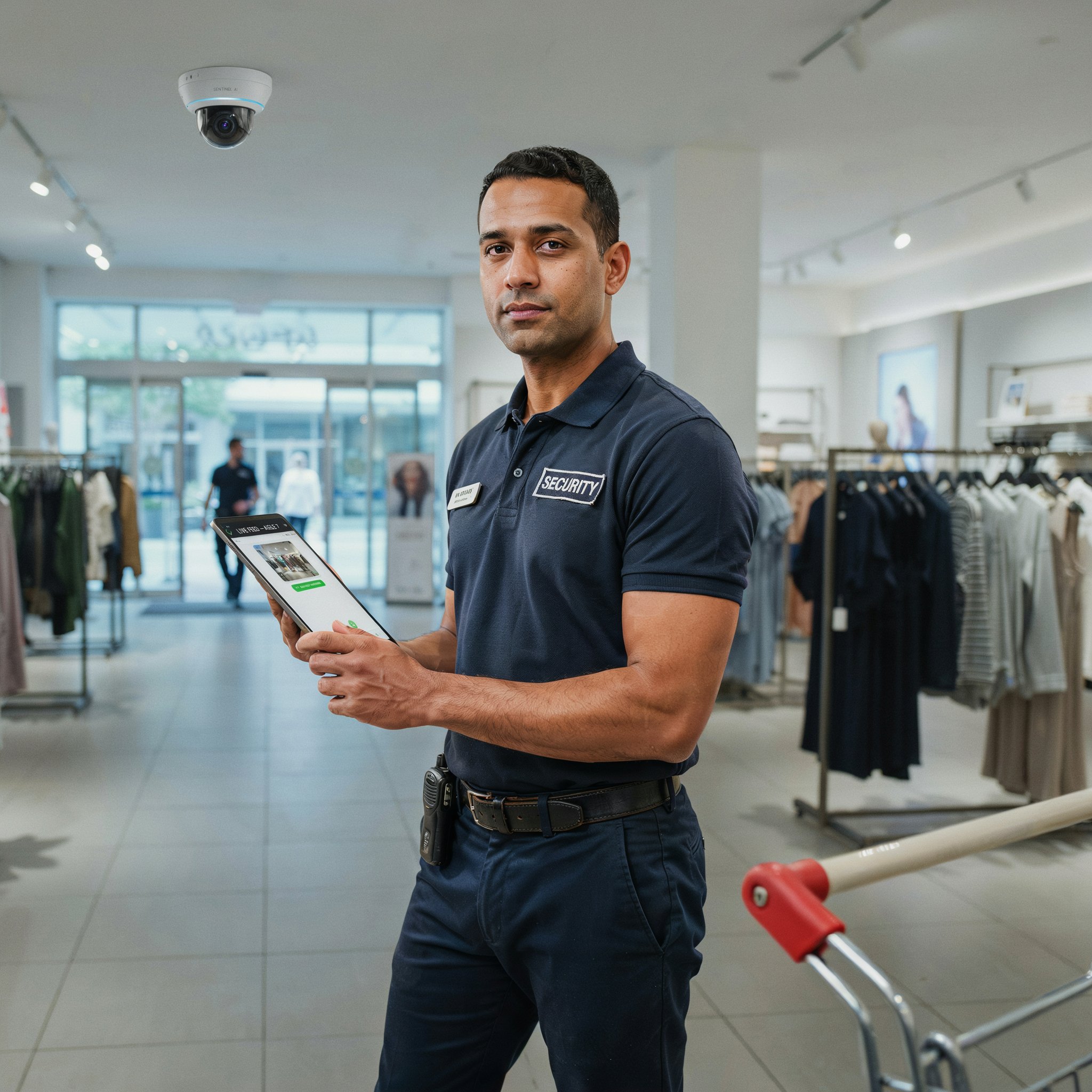
The Role of a Retail Security Guard in 2026
Retail security guard. It’s a job title that a lot of people think they understand — until they actually spend time watching what a properly trained guard does inside a busy store for eight hours straight.
The image most people carry is outdated. A bloke standing near the entrance, arms crossed, vaguely intimidating. That version existed — it still does, in places that don’t take security seriously. But in 2026, the stores that are actually winning the fight against theft are running something completely different. Their retail security guards are trained observers who catch problems early, de-escalate situations before they blow up, know the legal lines they can and cannot cross, and often become the most approachable person on the floor for customers who need help.
That shift didn’t happen by accident. It happened because the theft problem forced it.
Australian retailers are now losing roughly $9.3 billion a year to theft-related shrinkage. The 2024 ANZ Retail Crime Study found that losses jumped about 40% in just two years. The Australian Bureau of Statistics reported that 2024 saw the highest theft incident count in 21 years — 595,660 victims nationally, with nearly half of those incidents happening inside retail stores. In Melbourne alone, police logged 47,800 theft and shoplifting offences across 2024–2025.
Those aren’t abstract numbers. Every one of them represents a transaction that went wrong, a product that never made it to the register, and often a staff member who had to deal with something they weren’t trained or paid to handle.
Professional retail security guards exist to stop that from happening — or, when it does happen, to make sure it’s handled properly.
What a Retail Security Guard Actually Does — The Real Version
Ask someone who’s never worked in loss prevention what a retail security guard does, and they’ll say “watches for shoplifters.” That’s true, but it’s a bit like saying a nurse “takes temperatures.” It’s one task among dozens, and far from the hardest one.
Here’s what a shift actually looks like.
Reading behaviour before anything happens. The most experienced retail store security guards will tell you that the moment of theft is almost never when they’re paying attention — it’s what leads up to it. Somebody who’s planning to steal has a different rhythm to someone who’s shopping. They move differently, look differently, handle products differently. A trained guard reads that. They’re monitoring patterns, not just watching hands. By the time merchandise goes into a bag, a good guard has already been watching that person for ten minutes.
Managing confrontations without making them worse. This has become one of the harder parts of the job. In 2026, offenders are bolder. It’s not just teenagers shoving chocolate bars into their pockets — it’s coordinated groups hitting multiple stores in a single afternoon, and they’re not interested in being politely asked to stop. A retail security guard in this environment needs to know when to step in, when to stand back and observe, when to call for backup, and when to disengage entirely to protect bystanders. That’s not instinct. That’s training.
Being a decent human being to customers. This one surprises people. Guards spend far more of their shift helping lost elderly shoppers, pointing people toward the right aisle, or calling an ambulance for someone who’s collapsed than they spend apprehending shoplifters. The best retail security guards understand that their visible presence sends two messages simultaneously — one to potential offenders, and one to customers who want to feel safe in the store. Both matter.
Working the technology, not around it. Modern retail environments have AI-assisted CCTV, electronic article surveillance systems at every exit, panic buttons behind counters, and in some larger stores, real-time monitoring feeds from off-site control rooms. A guard who understands how these systems work — who knows what the EAS alarm actually means, how to pull relevant footage, how to document an incident in a way that’ll hold up if police need it — is worth significantly more than one who treats the camera system as someone else’s problem.
The Retail Crime Environment in Australia Right Now
Let’s be honest about what’s actually happening on the ground in 2026, because the nature of the problem shapes the role.
Opportunistic theft is still the most common category — someone grabs something and walks. Cost-of-living pressure has pushed more people into that column who wouldn’t have been there five years ago. But opportunistic theft is also the category most responsive to visible deterrence. A uniformed retail security guard near a high-value display genuinely changes the math for someone who’s debating whether to pocket something.
Organised retail crime (ORC) is the more alarming trend. These are coordinated operations. Multiple people, defined roles — one person distracts staff, one grabs merchandise, one runs interference near the exit. Australian Federal Police estimate ORC accounts for somewhere between 30% to 40% of total retail theft value, despite being less than 10% of incidents by count. Some groups use foil-lined bags to defeat EAS tags. Some have been coordinating on social media platforms to plan simultaneous hits across multiple stores in a suburb. These operations require a different response — one that plain-clothed loss prevention officers are much better equipped to deliver than visible guards working alone.
Staff violence and intimidation has increased sharply. Retail workers — many of them young, casual, and working alone at specific times of day — are being physically and verbally threatened at a rate that would have been hard to imagine a decade ago. In Victoria, major supermarket chains have publicly flagged the scale of the problem. The National Retail Association runs state-based Retail Crime Committees specifically to address how dangerous this has become for frontline workers.
What unifies all three of these categories is that none of them can be adequately addressed by camera systems alone, by self-checkout auditing software, or by asking store staff to handle them. Each one requires a trained human being who knows what they’re doing and has the authority to act.
Protecting Staff — The Part Nobody Talks About Enough
When retailers ring us about retail security guard services, they usually lead with stock loss. That’s understandable — shrinkage hits the P&L directly, and it’s measurable. But when we actually talk to store managers, the conversation almost always circles back to something harder to quantify: what it’s doing to their team.
Retail staff aren’t security professionals. They’re there to help customers, process transactions, stock shelves. Asking them to manage aggressive shoplifters, confront suspected thieves, or deal with someone who’s intoxicated and abusive is not just unfair — it’s genuinely dangerous, and it creates significant legal liability for the business.
When there’s a professional retail store security guard in the building, that dynamic changes. Staff know they have someone to call. Customers know there’s someone watching. And potential offenders — particularly the opportunistic ones — do their calculation and walk out empty-handed.
Morale improves. Absenteeism drops. Staff actually stay in the job longer, which matters in an industry where turnover is already brutal. These aren’t soft outcomes — they’re bottom-line outcomes.
Uniformed Guards vs. Plain-Clothed Officers: What’s the Difference and When Do You Need Each
This is a question worth spending time on, because the answer changes based on what your store actually deals with.
Uniformed retail security guards are primarily deterrents. Their presence sends a visible signal — to would-be shoplifters, to customers, and to staff — that this business takes security seriously. In high-traffic environments like supermarkets, hardware chains, and major shopping centres, that visibility does a lot of work. Opportunistic theft drops because the risk calculation changes for potential offenders the moment they walk in and see a uniform.
Plain-clothed loss prevention officers work differently. Without the uniform, they can move through a store without changing how people behave. They watch, follow, and confirm before acting. They’re far more effective against sophisticated shoplifters who understand how to work around visible security positions — who’ve learned to wait until the uniformed guard is distracted before making their move. For stores that deal regularly with organised retail crime, plain-clothed officers are often the most important investment.
Most well-run retail security programs use both. Visible deterrence at the entry points and high-theft areas, plain-clothed observers working the floor. The right ratio depends on your store’s layout, the value of your merchandise, your theft history, and your customer profile.
FoxWatch Security’s retail security deploys both options, and we do an initial site audit before recommending anything — because applying a standard package without understanding the specific environment is how retailers end up paying for security that doesn’t address their actual problem.
How Location Changes the Role: Melbourne, Brisbane, and Gold Coast
Retail crime isn’t geographically uniform, and effective retail security guard services need to account for that.
Melbourne has the most concentrated retail theft problem in Victoria. The CBD and inner suburbs carry the highest incident rates in the state, driven partly by organised groups that have learned the layout of major shopping precincts in detail. Electronics, luxury goods, and pharmacy products are frequent targets. Guards working in Melbourne environments need experience with dense, complex shopping centre layouts and the specific patterns of ORC groups operating in Victoria. They also need to be across the regulatory framework under Victoria’s Private Security Act.
Brisbane and Queensland present a different picture. Pharmacy-targeted theft, fast-moving groups hitting multiple locations, and after-hours break-ins are all prominent in Queensland’s retail crime profile. Guards in Brisbane need to know Queensland’s Security Providers Act framework, understand how to preserve evidence for successful prosecution through Queensland Police, and recognise ORC patterns specific to the state.
Gold Coast is its own challenge. Tourism drives the economy, which means foot traffic can spike dramatically during peak seasons — and theft opportunity spikes with it. Seasonal workers, unfamiliar store layouts for visitors, and the specific profile of tourist-oriented retail all change the equation. Retail security on the Gold Coast requires guards who can work effectively in a busy, unpredictable environment and adapt quickly when crowd profiles shift.
FoxWatch operates across all three cities with local teams who understand these differences from firsthand experience. That matters more than people realise — a guard who’s only ever worked in quiet suburban environments is not well-placed to handle a complex urban shopping centre.
What Professional Retail Security Looks Like in Practice
Let’s make this concrete. Here’s what a well-run retail security operation actually involves in 2026.
A guard arrives for a shift and reviews any incidents from the previous 24 hours — not because someone tells them to, but because that context changes how they work the floor that day. Known repeat offenders, recent patterns, areas of the store that have been targeted. They walk the environment before the store opens, checking that EAS systems are functioning, that blind spots are noted, that the communication channel with the control room is live.
During trade, they’re moving. Standing in one spot for eight hours is what bad security looks like. Good retail security guards have a pattern that’s unpredictable enough that someone watching can’t map it, but thorough enough that every high-risk area gets attention regularly. They talk to staff. They greet customers. They stay visible in some places and deliberately inconspicuous in others.
When something happens — an alarm triggers, a staff member signals, they observe something themselves — they respond calmly and proportionately. They know what they’re legally permitted to do in Queensland, Victoria, or wherever they’re operating. They document properly because a poorly documented incident that goes to police or court can collapse entirely. They protect the evidence chain.
After the shift, they brief the incoming guard and complete incident reports. Those reports go somewhere useful — into a system that tracks patterns, feeds back to management, and informs whether the deployment strategy is actually working.
That’s what professional retail security guard services look like. It’s not glamorous. But it’s what actually stops the bleeding.
How Retail Security Fits Into a Broader Loss Prevention System
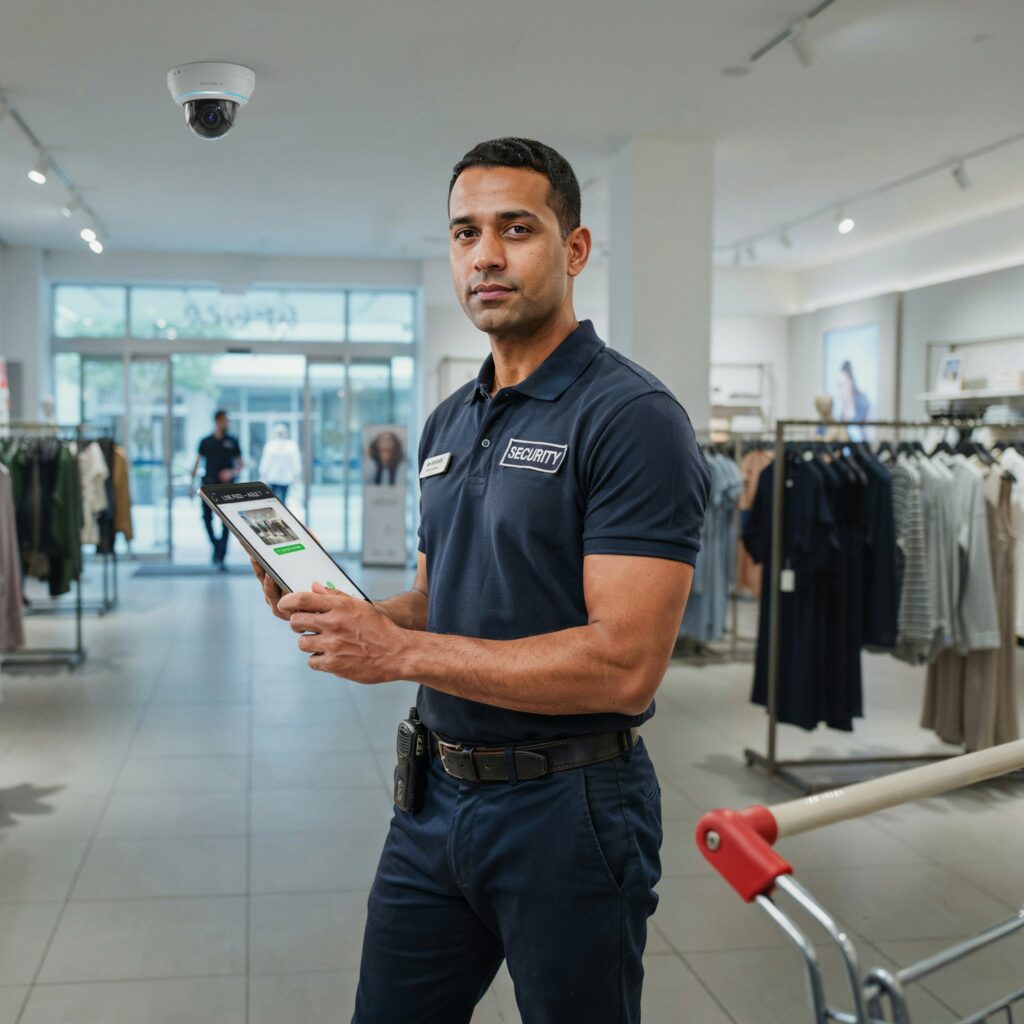
A retail security guard working without any supporting systems is less effective than one embedded in a properly designed loss prevention structure.
EAS systems — the hard tags and soft labels on merchandise — deter casual theft and trigger alarms at exits. But they only work when someone responds to those alarms professionally and immediately. Without a trained guard, a triggered EAS alarm teaches shoplifters that they can walk through it without consequence. With one, it’s an intervention point.
CCTV and analytics have moved well beyond passive recording. Modern systems can flag loitering, identify movement patterns associated with concealment behaviour, and in some cases alert to known offenders using facial recognition within privacy law parameters. Guards working alongside live monitoring are significantly more effective than those who can only see what’s directly in front of them.
Staff training is a layer that’s often underinvested. When retail employees know what to look for, know how to signal a guard discreetly, and know what not to do when they suspect theft, they become a genuine early warning system. FoxWatch provides staff training alongside guard deployment as part of a complete retail security approach.
Alarm response covers the hours when the store is closed. Break-ins, vandalism, and after-hours burglaries are a real category of loss for Australian retailers. Our alarm response service puts a trained guard on-site when the alarm goes off — not a call centre operator asking questions on the phone, but someone physically present who can assess the situation, secure the premises, and coordinate with police.
What to Ask Before You Hire a Retail Security Provider in Australia
Every security company in Australia will tell you they’re the best. Here’s how to cut through that.
Do their guards hold current licences for your state? In Queensland, that’s under the Security Providers Act. In Victoria, the Private Security Act. Licences aren’t optional — unlicensed guards expose your business to liability that you don’t want to carry.
Are they ASIAL certified? The Australian Security Industry Association Limited certification is the industry benchmark. It means the company is operating to a defined professional standard and is subject to independent oversight.
Have they worked in your type of retail environment before? A guard experienced in shopping centre environments has a completely different skill set to someone who’s worked in small independent retail. These don’t translate automatically.
What does their incident reporting look like? Ask for a sample incident report. If it’s vague, incomplete, or doesn’t include the information needed to support a police report or a civil claim, that’s a problem.
How do they handle guard turnover? High turnover is endemic in parts of the security industry. Frequent guard changes mean no institutional knowledge, no pattern recognition, no relationships with your staff. Ask directly what their retention rates look like.
Why More Australian Retailers Are Treating Security as a Business Investment
The retailers who used to view security as a cost to minimise are changing their minds — fast.
When shrinkage runs at 3.7% of total retail turnover, which is the industry average reported by the Australian Retailers Association, even a modest reduction in that figure justifies significant investment. A business doing $5 million in annual turnover is losing $185,000 to shrinkage. If professional retail security guard services cut that by 30%, you’ve recovered $55,500 a year — often more than the cost of the security contract.
That’s before you account for reduced staff compensation claims, lower insurance premiums in some cases, and the customer retention impact of having a store that feels safe to shop in. Consumers notice when a store is chaotic. They notice when staff look stressed and scared. They also notice when things run calmly and professionally.
The stores doing this properly in 2026 aren’t treating security as a reaction to problems. They’re building it into their operational model from the start.
If you operate retail across Brisbane, Melbourne, or the Gold Coast and you haven’t had a proper security assessment in the past 12 months, that’s worth fixing now.
Reach out to FoxWatch Security for a free retail security audit. We’ll walk through your environment, look at your current setup honestly, and give you a realistic picture of where the gaps are — without trying to sell you solutions you don’t need.
FoxWatch Security: Retail Security Guards Across Melbourne, Brisbane, and Gold Coast
FoxWatch Security provides professional retail security guard services to retailers across Melbourne, Brisbane, and the Gold Coast. Our guards are fully licensed, ASIAL-compliant, and trained for the specific demands of retail environments — not just general security principles applied to a retail context.
We deploy uniformed and plain-clothed personnel based on what your store actually needs, integrate with your existing technology systems, provide staff training, and back everything up with after-hours alarm response coverage.
See our full retail sector security approach or contact our team to talk through your requirements.
Frequently Asked Questions
Q1: What does a retail security guard do in Australia?
Deters theft, monitors behaviour, responds to incidents, supports staff during confrontations, and coordinates with CCTV and EAS systems to protect stock, staff, and customers throughout each shift.
Q2: Are retail security guards required by law in Australian stores?
No legal requirement, but professional retail security guard services significantly reduce theft losses and legal exposure. Rising incident rates make them a sound operational investment for most stores.
Q3: What is the difference between a retail security guard and a loss prevention officer?
Loss prevention officers specialise in shoplifting detection, ORC identification, and evidence collection. Retail store security guards cover a broader scope including visible deterrence, customer management, and real-time incident response.
Q4: How much do retail security guard services cost in Australia?
Costs vary by location, deployment type, and hours needed. FoxWatch offers a free site audit first. Contact us for a quote specific to your store and risk profile.
Q5: Does having a visible security guard actually reduce theft?
Yes. Industry data consistently shows professional retail security guard deployment cuts theft incidents by 30–50%. Visible deterrence most strongly affects opportunistic shoplifters, who account for most incidents.
Comments are closed