
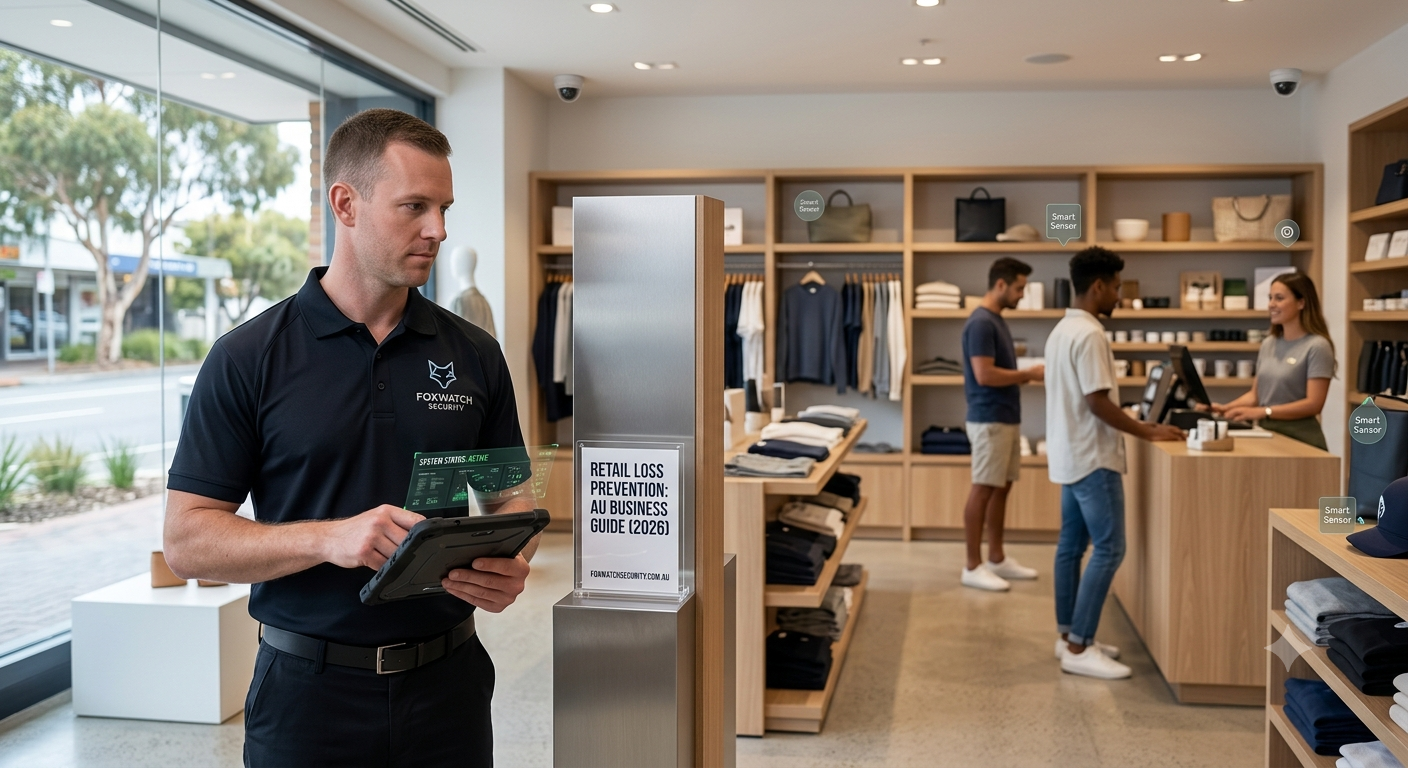
2026 Retail Loss Prevention Guide for AU Businesses
Retail Loss Prevention 2026 is no longer a checkbox on a store opening manual. It is a line item that’s now big enough to show up on a profit and loss statement, and Australian retailers from Perth to Hobart are feeling it in real time. If you own, manage or run loss prevention for a retail business anywhere in the country, this guide is built for you specifically — not a generic overseas playbook, and not just for one city.
We work with retail operators across Melbourne, Brisbane and the Gold Coast, and the same conversation keeps coming up no matter the postcode: shrinkage is climbing, staff are getting nervous about confrontations, and the old “just put a camera near the door” approach stopped working a few years ago. So let’s get into what’s actually happening across Australia in 2026, and what a sensible retail loss prevention plan looks like depending on where your store sits.
What Is Retail Loss Prevention, Really?
Let’s answer the obvious question first, because a lot of business owners ask it and get a vague answer. What is retail loss prevention? In plain terms, it’s everything a retail business does to stop stock, cash and revenue disappearing before it should — whether that’s walking out the front door in someone’s jacket, vanishing through a dodgy refund, or going missing somewhere between the warehouse and the shop floor.
It covers four overlapping problem areas:
- External theft — shoplifting, organised retail crime, and “boosting” by groups working in pairs or teams
- Internal theft — staff taking stock, manipulating the till, or colluding with outside thieves
- Process and admin errors — pricing mistakes, damaged stock written off incorrectly, receiving errors
- Fraud — return fraud, refund scams, and increasingly, self-checkout manipulation
Most owners think of loss prevention in retail stores as just “stopping shoplifters.” That’s a piece of it, but it undersells the job. A proper loss prevention retail program touches your floor layout, your point-of-sale process, your hiring, your CCTV, and your physical security all at once.
The Numbers Australian Retailers Are Actually Dealing With
We won’t bury you in stats, but a handful matter enough to shape your decisions this year.
Police-recorded theft across Australia hit its highest level in 21 years, with roughly 595,660 victims of theft (excluding motor vehicle theft) recorded nationally — a 6% jump in a single year. What should really catch your attention is where that theft is happening. Back in 2010, retail premises accounted for around 31.6% of all recorded theft locations nationally. By 2024, that figure had climbed to 45.1%. Retail stores aren’t just one category of theft location anymore — they’re close to half of the whole national picture.
The Australian Retailers Association has reported that around 70% of retailers experienced a rise in customer theft over the past financial year, and shrinkage now averages somewhere around 3–4% of turnover for a typical Australian retail business. On a store doing $1.5 million a year, that’s tens of thousands of dollars simply gone — not stolen in one dramatic incident, but bled out a few items at a time, day after day.
Organised retail crime is the part keeping retail executives up at night. Major chains including Bunnings and Coles have publicly flagged coordinated theft rings targeting high-resale items — power tools, premium spirits, designer clothing, electronics, infant formula. These aren’t impulsive grabs. They’re planned, often with a lookout, a distraction, and a getaway, and the goods are usually resold online within days.
There’s also a cultural shift worth knowing about, because it changes how your frontline staff should think about prevention. A Monash University study in 2025 found more than one in four Australian shoppers now believe some form of retail theft is justifiable, and that figure jumps to over half among shoppers aged 18 to 34. Self-checkout, in particular, has made theft feel less personal — people who’d never dream of stealing from a person feel differently about an unmanned scanner and a faceless corporation.
Retail Loss Prevention Laws Differ by State — Here’s What That Means for You
This is the part a national guide actually needs to get right, and it’s where a lot of generic advice falls flat. Theft law in Australia isn’t one law — it’s eight separate state and territory frameworks, and the thresholds that decide whether police treat an incident as a minor matter or a serious charge are genuinely different depending on where your store is.
New South Wales: Shoplifting is prosecuted as larceny under the Crimes Act 1900. Minor offences involving goods valued at $300 or less are often handled with an on-the-spot $300 penalty notice that doesn’t leave a criminal record. Anything above that can escalate to a Local or District Court matter, with maximum penalties scaling up sharply once the value passes $5,000.
Victoria: Theft falls under the Crimes Act 1958, and here’s the detail that surprises a lot of owners — there’s no low-value shortcut. Stealing an item worth $20 can technically carry the same maximum penalty exposure as stealing $90,000 worth of goods, because almost all shoplifting cases are heard summarily in the Magistrates’ Court regardless of value, with fines that can run into the tens of thousands.
Queensland: This one has a hard dollar line. Goods valued at $150 or under are dealt with as a regulatory offence carrying a fixed fine. Cross that $150 threshold and you’re looking at a stealing charge under the Criminal Code, carrying up to five years’ imprisonment.
Why does this matter for your Retail Loss Prevention 2026 planning? Because how you document an incident — the exact value of goods, clear CCTV, an accurate written statement — directly affects whether police can act on it at all, and which threshold it falls under. A vague description and blurry footage might mean a $150 theft in Queensland gets waved off as too minor to pursue, when better evidence would have pushed it into a chargeable offence. The same applies in every state: better documentation gets better outcomes from police.
One thing is consistent everywhere in Australia, and it’s worth repeating clearly: in no state can ordinary retail staff or contracted security lawfully detain, restrain or search a suspected shoplifter. The legal position across the country is the same — observe, document, contact police. We train every officer we place on retail floors to hold that line without exception, because the legal and safety risk of getting it wrong is far higher than the cost of a missed recovery.
How to Prevent Shoplifting in Stores: A Layout-First Approach
If you only take one section of this guide and act on it tomorrow, make it this one. How to prevent shoplifting in stores starts with your floor, not your gadgets.
Walk your own store like a stranger would. Most owners stop “seeing” their layout after the first few months. Spend twenty minutes walking your aisles as if you’d never been in before. Where can’t you see from the till? Where would you hide something if you wanted to? Tall shelving near the back, blind corners by fitting rooms, and exits that aren’t covered by staff sightlines are the classic gaps.
Put high-theft stock where it’s hardest to lift. Cosmetics, vitamins, alcohol, fragrance, small electronics and baby formula are consistently the most targeted categories nationally because they’re compact, high value, and easy to resell. Move them near the counter or into a locked or tagged display rather than leaving them on an open shelf near an exit.
Acknowledge every person who walks in. This sounds almost too simple to matter, but it’s one of the most consistently effective shoplifting deterrents retailers have. A genuine “morning, give us a shout if you need anything” removes the anonymity a thief is counting on. It costs nothing and works on almost every customer interaction.
Train staff to read behaviour, not profile people. The signals that matter are behavioural — someone watching staff more than products, bulky clothing inconsistent with the weather, working in a pair where one distracts and one moves, repeated visits without ever buying. None of that has anything to do with how someone looks, and good training keeps staff focused on actions, not appearance.
Use cameras that actually identify someone. A camera angle that only ever captures the top of a cap is footage for the bin, not evidence. You want at least one identification camera covering faces clearly at the entrance, plus broader overview coverage across the floor. Stores that invest in real commercial security systems — proper coverage paired with monitored alarms — consistently report fewer incidents and far better outcomes when police do get involved.
For stores wanting a tailored walkthrough of their specific floor and risk profile, our retail security services page covers how we structure coverage for different retail environments, from boutique shopfronts to larger format stores.
Building a Layered Retail Loss Prevention Strategy
The retailers getting genuinely good results in 2026 aren’t relying on one single tactic — they’re layering several, so each one covers a gap the others leave open.
A visible person at the entrance, whether that’s an engaged staff member or a dedicated security guard, deters the opportunistic shopper before they’ve made a decision. Clear, well-positioned CCTV builds a usable case against the organised crews who aren’t deterred by a friendly greeting. Monitored alarms and after-hours mobile patrol coverage close the overnight gap, which is when break-ins and smash-and-grab incidents on high-value categories like electronics and jewellery tend to happen. And for retailers running multiple sites, coordinated corporate security arrangements mean your loss prevention approach is consistent across every location instead of reinvented store by store.
This layered approach also covers the after-hours alarm side properly. If a break-in trips your alarm at 2am, what actually happens next matters as much as the alarm itself. Our alarm response service is built around getting a real person on-site fast, rather than leaving your stock exposed until you wake up to a phone notification.
The mindset shift that matters most here is moving from reactive to proactive. Reviewing CCTV after a loss tells you what happened — it almost never gets the stock back. Stopping the theft at the point of attempt is the only version of loss prevention that actually protects your margin, and that only happens with visible, consistent coverage rather than a camera quietly recording in the corner.
Where You’re Trading Changes What You Need
Retail loss prevention also depends heavily on your location and store type, and this is where a one-size-fits-all national checklist tends to fall short.
High-footfall CBD and entertainment precincts deal with a lot of opportunistic theft hiding in crowd density — people count on being one face among hundreds. Suburban shopping centres, particularly ones with strong electronics, cosmetics or liquor offerings, tend to attract more organised groups targeting specific resale categories. Standalone strip shops away from a centre’s shared security often face their biggest risk after hours, when there’s no shared mall security walking past every twenty minutes.
We support retailers across Melbourne, Brisbane and the Gold Coast, and the honest answer every time a new client asks “what do I need?” is: it depends on your actual floor, your actual stock mix, and your actual trading hours. That’s why we start every engagement with a walkthrough rather than a standard package.
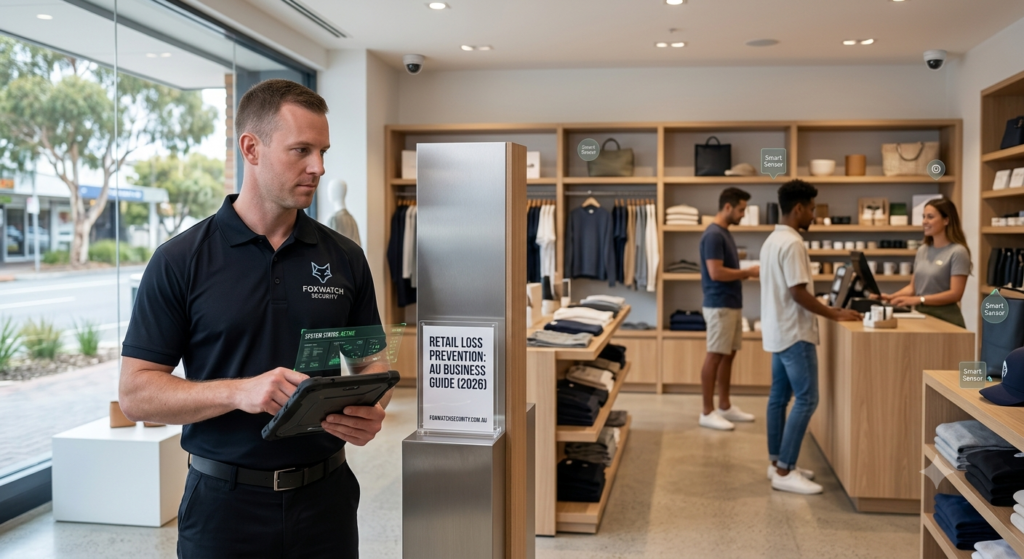
Five Things to Action This Quarter
If your 2026 loss prevention plan is still sitting as an idea rather than an action list, here’s where to start:
- Audit your blind spots. Walk the floor, note every spot you can’t see from the till or front of store, and fix the obvious ones with mirrors, shelving changes or repositioned stock.
- Check your CCTV actually identifies people. If your entrance camera can’t capture a clear face, that’s a gap worth closing before it costs you a case.
- Train staff on the legal line. Make sure every team member knows they observe and report — they never detain or search — and that this rule doesn’t change no matter how confident they feel.
- Review your after-hours coverage. If your highest-value stock sits exposed overnight with only a basic alarm, that’s the gap organised crews are increasingly exploiting.
- Document incidents properly. Accurate stock values, clear footage and a written staff statement make the difference between police being able to act and an incident going nowhere.
Talk to FoxWatch Security About Your Store
We’ve spent close to a decade protecting retail, hospitality and commercial sites across Melbourne, Brisbane and the Gold Coast. Our retail-trained officers aren’t generalists rotated in from other contracts — they’re briefed specifically on loss prevention, behavioural observation, evidence handling, and calm, lawful intervention that protects your stock without putting off honest customers.
If shrinkage is cutting into your margin this year, the most useful next step is a proper walkthrough of your actual store, not a generic quote over the phone. Get in touch with our team and we’ll talk through what your specific business actually needs — no template, no upsell, just a plan built around your floor.
Frequently Asked Questions
What is retail loss prevention?
It’s the combined effort — security staff, CCTV, alarms, staff training and process controls — that Australian retailers use to reduce shoplifting, internal theft, fraud and stock loss.
How much does shrinkage typically cost an Australian retailer?
Industry data puts average shrinkage at around 3–4% of turnover, meaning a $1.5 million store can lose tens of thousands of dollars a year unnoticed.
Do retail theft laws differ between Australian states?
Yes. NSW, Victoria and Queensland each apply different value thresholds and penalties, which affects how incidents should be documented and reported to police.
Can store staff detain a suspected shoplifter in Australia?
No, not in any state or territory. Staff and security can observe, document and contact police, but lawful detention or searching isn’t permitted.
What’s the most effective first step for small retailers?
A proper floor walkthrough to spot blind spots, paired with visible staff engagement and clear identification-quality CCTV at the entrance.
Comments are closed