
Why Melbourne Warehouses Choose Mobile Patrols in 2026
Melbourne warehouse mobile patrols have gone from being a “nice to have” to a genuine operational necessity — and warehouse managers across the city’s industrial belt will tell you exactly why.
Talk to anyone running a mid-sized warehouse in Truganina, Dandenong, or Campbellfield and they will describe the same experience. You arrive Monday morning, roll up the dock door, and something is wrong. A side gate has been forced. A pallet of goods is gone. The CCTV captured the whole thing — beautifully — at 2:47 am on Sunday. The footage is clear. The offenders are gone. The stock is gone. And you are left standing there wondering why a camera system that cost thousands of dollars did absolutely nothing to stop what happened.
That is the reality that is pushing Melbourne’s warehouse operators toward mobile patrol security in 2026. Not marketing brochures. Not trend-chasing. Just the cold experience of finding out the hard way that passive security is not the same as actual security.
What Is Actually Going On With Warehouse Crime in Melbourne Right Now
Victoria’s crime figures are not reading well for industrial operators. Reported burglaries across the state rose by more than 8% year-on-year through 2024-2025. Cargo and warehouse-related theft across Australia climbed 27% in the four years to 2023. Electronics, pharmaceuticals, and high-value FMCG goods make up the bulk of those losses — exactly the categories that Melbourne’s western and northern logistics corridors hold in abundance.
The suburbs worth paying attention to are the ones you already know are busy: Truganina, Derrimut, Laverton North, Altona North, Campbellfield, Somerton, Epping, Dandenong, Keysborough, and Braeside. These are Melbourne’s warehouse heartland. They are also where theft pressure is highest, partly because there is so much to steal and partly because the sheer density of industrial sites means that police response to any individual alarm is slow.
What makes the situation worse is the pattern. These are not always random hits. Organised groups scout sites in the daytime — sometimes posing as delivery drivers, sometimes just driving through industrial estates and noting which sites look easy. They look for predictable schedules, gaps in lighting, loading docks with no camera coverage, and alarm systems that take forever to get a response. When they return at night, they know what they are walking into.
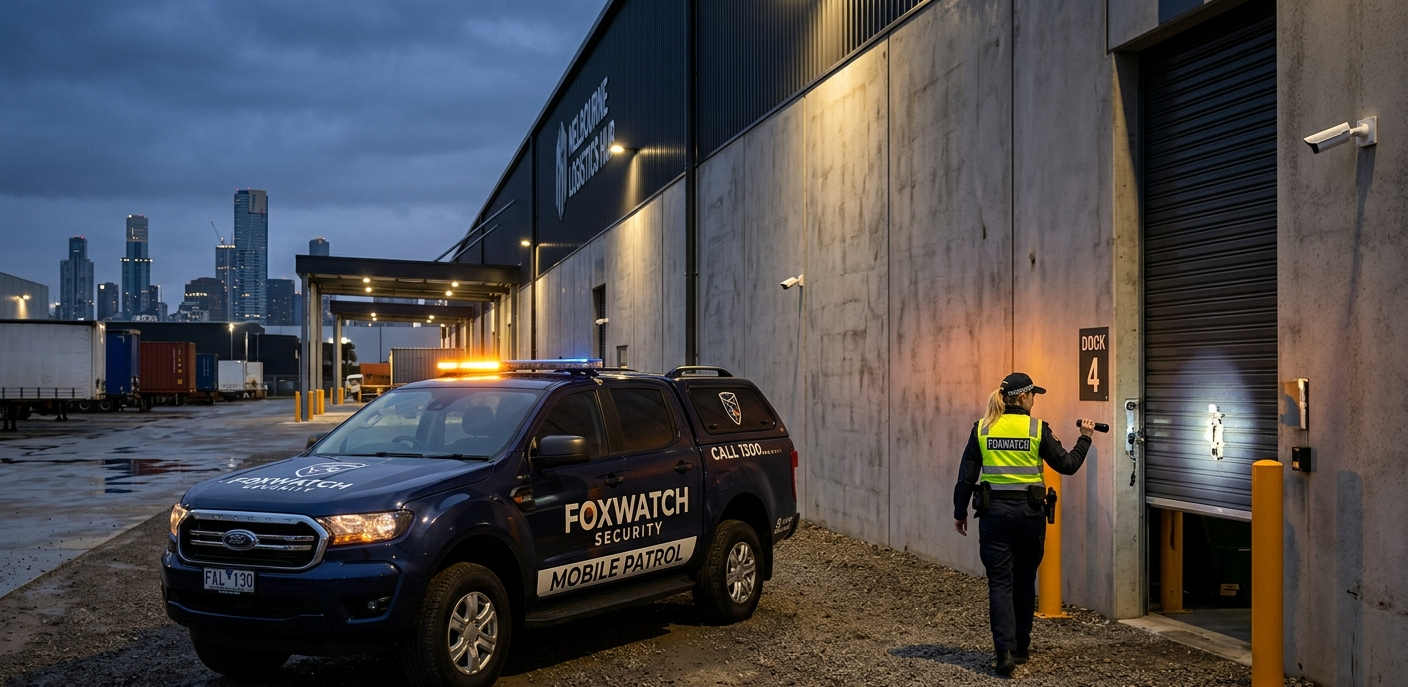
Mobile patrol security Melbourne breaks that pattern. A patrol vehicle that shows up at unpredictable intervals, with a licensed officer who actually walks the perimeter — that is what throws the calculus off for organised and opportunistic thieves alike.
What Melbourne Warehouse Mobile Patrols Actually Look Like
There is a common misconception that a mobile patrol is just someone driving past your front gate once at midnight and ticking a box. That is not what proper warehouse mobile patrols Melbourne look like.
A well-structured patrol service for a Melbourne warehouse will cover several things every single visit.
The officer does a full perimeter check on foot — not just a drive-by. They test loading dock locks, check roller door latches, look at perimeter fencing for signs of tampering or cutting, and walk the areas that cameras do not cover well. Racking yards, transformer enclosures, service corridors on the blind side of the building — the spots that every site manager knows exist but hopes nobody else has noticed.
Every visit is logged. GPS data records the exact time the officer arrived, the route they walked, and when they left. If something is found — a gate lock that has been interfered with, a window that should not be open, a vehicle parked where it has no reason to be at 3 am — it is reported immediately. The site manager gets a notification, not a report three days later.
Alongside the scheduled inspections, professional warehouse patrol security services Melbourne also build in random patrol checks at varying intervals. The randomisation is not incidental — it is one of the most important elements of the whole approach. The moment a potential intruder can predict when a patrol will arrive, they can plan around it. When they cannot, they tend to choose a different target.
The other service that gets overlooked by operators until they have their first incident is alarm response. When a warehouse alarm triggers at 2 am, someone needs to physically attend. Police are not always quick to respond to commercial alarm activations — it can take thirty minutes or more depending on what else is happening across the city that night. A dedicated mobile patrol security Melbourne operator with officers already on the road in your area can have someone on site in under 20 minutes. That difference — between a fast physical response and a slow one — is often the difference between catching an incident in progress and arriving to a cleared scene.
Lock-up and unlock services round out the offering for most warehouse clients. Roller doors left up, gates not properly latched, sensor doors propped open for a last-minute job — these are the access points that cause incidents. Having a licensed security officer confirm the site is properly secured at close of business removes a significant and common vulnerability.
The Specific Threats Facing Melbourne Warehouses in 2026
Loading Docks Are Still the Weakest Point
Ask any security professional who works regularly across Melbourne’s industrial estates which part of a warehouse gets breached most often, and they will tell you: the loading dock. It is designed for fast access during operations — wide openings, minimal obstruction, often positioned on the side or rear of the building away from street visibility. After hours, those same features make it the easiest point of forced entry on the site.
Loading dock security in a patrol context means the officer specifically checks dock doors and roller shutters, looks at whether dock levellers are securing the gap properly, and tests latching on any manually operated doors. It sounds basic. It is also the check that prevents a significant portion of after-hours entries.
Stock Theft Is Not Always Dramatic
Not every warehouse theft involves a van and a forklift at 2 am. A substantial portion of stock theft prevention work involves lower-level, systematic inventory loss that warehouse managers often attribute to admin errors before they realise what is actually happening. Organised groups sometimes target sites multiple times at small scale — taking amounts that fall below the threshold of triggering a formal incident review — because they know the site has no physical patrol presence to make them uncomfortable.
Regular warehouse security patrols change that dynamic. The knowledge that a licensed officer is visiting unpredictably at night changes behaviour — including among people with inside knowledge of the site.
Vandalism Causes More Damage Than It Looks
A roller door that has been forced and re-closed. A perimeter light that has been knocked out. A camera housing that has been repositioned slightly. These are early-warning signs that a site is being prepared for a bigger event — and they are exactly what a patrol officer on foot will notice that a remote monitoring system will not. Vandalism prevention in a warehouse context is partly about stopping graffiti or malicious damage, but more importantly it is about catching the precursor activity that precedes a serious theft.
Trespassing Carries Real OHS Exposure in Victoria
Unauthorised individuals on a warehouse site is not just a theft risk — it is a workplace health and safety liability under Victorian law. Warehouses carry genuine hazards: forklifts, racking at height, stored chemicals, loading equipment. An intruder injured on a site has legal grounds to pursue the site operator in certain circumstances. Trespassing prevention through regular patrols, suspicious activity checks, and documented site access control is part of managing that exposure, not just securing the stock.
CCTV and Alarms Do Not Replace a Physical Presence
This is worth saying plainly because the conversation comes up every time a warehouse operator is trying to justify their security spend.
A good CCTV system is genuinely useful. It deters some opportunistic behaviour, it captures evidence, and it provides footage that police and insurers will want after an incident. If it is connected to a live monitoring service, it can also trigger an alarm response. None of that is irrelevant.
But cameras have blind spots. On most warehouse sites — with racking, shipping containers, yard equipment, and external structures creating obstruction — a comprehensive camera system still leaves coverage gaps. Those gaps are often the ones that experienced offenders specifically target.
More fundamentally, cameras record. They do not intervene. Warehouse break-in prevention requires a deterrent that responds to events in real time, not one that documents them. A marked patrol vehicle in your car park at 1:30 am is a deterrent. An HD camera recording the same car park is not, if the offender already knows nobody will see that footage until morning.
Warehouse perimeter patrols by officers on foot are the component that fills the gap between electronic surveillance and actual prevention. The patrol officer finds the pushed-back fence section before it becomes a point of entry. They notice the utilities vehicle sitting dark on the service road behind the dock with no obvious reason to be there. They check whether the alarm sensor on the rear fire door is still properly engaged. These are judgment calls a licensed officer makes on the ground that no camera or monitoring system can replicate.
Mobile Patrols vs. Permanent Guards: How Warehouse Operators Are Thinking About It
This is a legitimate question, and the honest answer depends on the site.
For a large distribution centre handling pharmaceuticals, electronics, or bonded goods, a permanent on-site guard presence — or a staffed gatehouse — makes sense. The value of stock on hand justifies the cost of continuous coverage, and the site will typically have 24-hour operational activity that makes a permanent guard both practical and visible.
For most Melbourne warehouse operations — third-party logistics sites, manufacturing warehouses, food and beverage storage, retail distribution — commercial mobile patrol security Melbourne delivers stronger value. A patrol officer covers multiple sites across a night, which is why the per-site cost is considerably lower than a permanent guard. GPS tracking and detailed reporting mean you do not lose accountability in exchange for that economy. You still have verifiable, timestamped records of every patrol visit.
A combination approach is what many operators settle on: a gatekeeper or guard at the main entry during operational hours, with mobile patrol security for warehouses handling after-hours perimeter checks, alarm response, and lock-up/unlock. FoxWatch Security works with warehouse clients across Melbourne to find the right blend rather than defaulting to a standard package.
Melbourne’s Industrial Corridors: Where Patrol Security Matters Most
Melbourne’s warehouse and logistics geography is concentrated in specific corridors that carry very different risk profiles.
Western suburbs — Truganina, Derrimut, Laverton North, and Altona North have grown dramatically on the back of e-commerce fulfilment and logistics expansion. High-value consumer goods flowing through these facilities make them attractive targets, and the relatively new development of many precincts means lighting, fencing, and site layout have not always kept up with the volume of activity.
Northern corridor — Campbellfield, Broadmeadows, Somerton, Epping, and Thomastown make up Melbourne’s traditional manufacturing and warehousing core. This is where industrial mobile patrols Melbourne have the longest history. Older buildings, mixed industrial tenancy, and distance from police response infrastructure make after-hours patrol coverage particularly important here.
South-east — Dandenong, Keysborough, Braeside, and Carrum Downs. The Dandenong precinct is one of Victoria’s largest industrial areas and sees consistent pressure in automotive parts, food manufacturing, and cold chain logistics. Logistics security Melbourne requirements here include specific protocols around refrigerated storage and high-value parts storage.
Logistics yard security — intermodal terminals, container yards, and freight depots need patrol approaches that account for 24-hour operations and very large open areas. The perimeter check on a container yard looks different from a warehouse, and the patrol provider needs to understand that.
FoxWatch Security’s industrial security team operates regularly across all of these corridors.
What Separates a Good Melbourne Mobile Patrol Provider From a Bad One
The security industry has providers at very different levels of quality, and warehouse operators sometimes find that out expensively. A few things worth looking at hard when evaluating warehouse patrol security services Melbourne:
Licensing is not optional. Every officer conducting patrols in Victoria must hold a current security industry licence. Ask to see it. If a provider is hesitant about providing evidence of officer licensing, stop the conversation there.
GPS reporting should be standard. Any reputable provider of GPS-tracked patrols will give you access to patrol logs showing exactly when officers arrived at your site, the route they completed, and when they left. If a provider cannot show you this, they cannot demonstrate that patrols are actually happening as contracted.
Alarm response time needs a specific commitment. For warehouse alarm response Melbourne, ask what the contractual response time guarantee is, how it is measured, and what happens if it is not met. “We aim to be there quickly” is not a commitment. A specific time — and a track record of meeting it — is what you need.
After-hours contact protocols matter more than you think. When something happens at your site at 3 am, who calls you, what information do they have, and what decisions are being made before that call? A patrol officer who rings to say “there might be something going on” is not managing the situation. Clear escalation protocols — officer responds, assesses, reports specific findings, contacts police if required, notifies designated site contact with details — is what functional incident management looks like.
Local experience is real value. A patrol provider who works Melbourne’s industrial precincts every night builds genuine operational knowledge — which areas generate frequent incident reports, where police response is faster, which patrol routes cover risk most efficiently. That local knowledge is not transferable from a provider who covers your area from a distant base.
The Cost Side of the Conversation
Melbourne warehouse operators running security on a tight budget sometimes see mobile patrol security for warehouses as a cost to be minimised rather than an investment to be right-sized.
Consider the maths from the other direction. A mid-sized Melbourne warehouse routinely holds $500,000 to $2 million in stock. A single targeted theft event — the kind where organised offenders take a pallet-load of high-value goods from a loading dock — can exceed $50,000 in direct product loss. Add property damage, the cost of the insurance claim process, the premium increase at next renewal, and the business disruption from a day of police attendance and investigation, and a single incident can cost more than a year’s patrol contract.
That is before you factor in what happens to client relationships. For third-party logistics operators specifically, a theft event at a client’s stored goods raises immediate questions about security arrangements. Those are commercially sensitive conversations that nobody wants to have.
After-hours warehouse security Melbourne is not an expense in this context — it is risk management with a measurable return.
Talk to FoxWatch Security about what a patrol arrangement calibrated to your specific Melbourne warehouse would look like and cost.
How FoxWatch Security Runs Warehouse Patrols in Melbourne
FoxWatch operates across Melbourne’s industrial precincts with a fleet of marked patrol vehicles and a team of fully licensed security officers. The operational model is built around a few things that warehouse clients have told us actually matter.
Officers are deployed with real local knowledge — not just a map and a client address. They know which industrial precincts generate the most incident activity, which patrol routes deliver the most effective perimeter coverage, and how to assess what they are seeing on a warehouse site at 2 am.
Patrols combine scheduled visits with random mobile patrols built into every shift. The scheduling is known to the client but not predictable to anyone else. That unpredictability is operational, not administrative.
Alarm response is integrated into patrol operations — officers on the road are the response, not a separate callout from a third party. Rapid alarm response from officers who are already nearby is what produces sub-20-minute attendance times.
Every visit generates a report. Anything out of the ordinary gets documented and reported immediately — a photo, a note, a call to the nominated contact. The documentation is usable for insurance and for Victoria Police if an incident progresses to an investigation.
FoxWatch’s wider Melbourne services — including alarm monitoring,corporate security, and full industrial security programs — are available to complement patrol operations where a layered security approach makes sense for the site.
Putting It Together: A Practical Warehouse Security Setup for 2026
Mobile surveillance patrols work best as part of a wider security setup rather than the only measure on site. What works well in practice across Melbourne warehouse operations:
Access control on entry points and loading docks — electronic or managed — so that after-hours access requires positive authorisation rather than just defeating a lock.
CCTV on perimeter, loading areas, car parks, and high-value internal zones, connected to a monitoring service that can trigger an alarm response and alert the patrol fleet.
An integrated alarm system where activations notify the patrol operator directly, not just the property owner and police, so the physical response is faster.
Scheduled and random patrol inspections covering the full perimeter on foot at every visit, with GPS-logged reporting accessible to site management.
Lock-up and unlock services to remove the human error at close of business that creates unnecessary after-hours vulnerabilities.
And honest security incident reporting after every visit — not a generic “all clear” but a documented account of what was checked, what was found, and what was done.
FoxWatch Security’s industrial clients across Melbourne are running setups built on these foundations. The operators who have had incidents in the past — and there are plenty who have — tend to be the most systematic about layering security properly.
Wrapping Up
Melbourne warehouse operators choosing mobile patrol security in 2026 are not chasing a trend. They are responding to a theft environment that has gotten measurably worse, with an approach that actually works in practice rather than one that produces good footage of incidents that have already happened.
Cameras have their place. Alarm systems have their place. But Melbourne warehouse mobile patrols — regular, documented, unpredictable, with a licensed officer physically on your site — are what bridge the gap between passive security and real protection.
If your warehouse is currently relying on cameras and hoping the alarm response will be fast enough, that is a gap worth closing before it closes itself in the worst possible way.
Contact FoxWatch Security for a no-pressure conversation about what a patrol setup calibrated to your Melbourne warehouse actually looks like.
Frequently Asked Questions
Q1: What do Melbourne warehouse mobile patrols include?
Scheduled and random perimeter checks, GPS-logged reporting, alarm response, loading dock inspections, lock-up/unlock, and suspicious activity checks by licensed security officers.
Q2: How fast can a patrol officer reach a Melbourne warehouse alarm?
FoxWatch targets under 20 minutes across Melbourne’s industrial corridors, with officers already on patrol in the area rather than dispatched from a base.
Q3: Are mobile patrols cheaper than a permanent warehouse guard?
Generally yes. Officers cover multiple sites per shift, keeping per-site cost lower while GPS reporting maintains full accountability. Most Melbourne warehouses find patrols the right fit.
Q4: Which Melbourne areas does FoxWatch warehouse patrol cover?
Truganina, Dandenong, Campbellfield, Epping, Somerton, Laverton, Keysborough, Braeside, Broadmeadows, and surrounding industrial precincts across Melbourne’s north, west, and south-east.
Q5: Can patrol visit reports support an insurance claim?
Yes. GPS-timestamped logs and written incident reports document the state of the site at each visit, providing verifiable evidence insurers and police investigators can use directly.
Comments are closed