
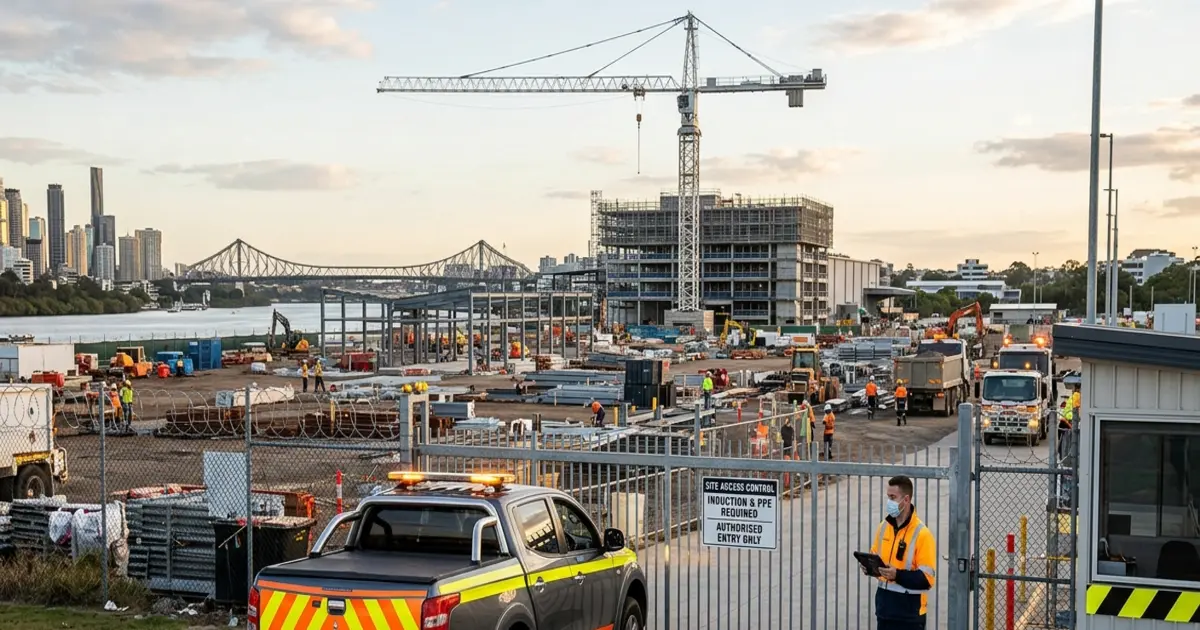
Industrial Site Security Brisbane: 2026 Liability & Safety
Industrial Site Security Brisbane in 2026 is not the same job it was even two years ago. Sites are busier, contractor headcounts are higher, plant is more expensive, and WorkSafe Queensland is far less forgiving when things go sideways. If you run a yard in Wacol, a build in Fortitude Valley, a distribution shed off the Gateway, or a plant near the Port of Brisbane, the liability sitting on your shoulders has quietly become the single biggest cost on your risk register.
This guide walks through what has actually changed, where sites are getting stung, and how the right security setup drops both your incident rate and your insurance exposure. No fluff. Just what has been working on live Brisbane sites this year.
Why Industrial Site Security Brisbane Matters More in 2026
Anyone who has walked a large Brisbane project lately can tell you the same thing: there are more moving parts than ever. A mid-sized industrial build in Yatala or Acacia Ridge might have twelve subcontractors on site in a single day. Deliveries roll in from 5 a.m. Cranes lift after dark. Fuel bowsers sit unattended over long weekends. Copper prices are up again, and organised theft crews are watching.
At the same time, the Work Health and Safety Act 2011 (Qld) has been enforced more aggressively. Category 1 offences carry serious penalties. Directors are being named. Principal contractors are being asked, quite directly, what “reasonably practicable” steps they took before the incident, not after.
Industrial Site Security Brisbane is no longer just a “guard on the gate” question. It is a documented, layered, auditable system that ties access, patrols, incident logs, and workplace health and safety compliance together. That is why we built our industrial security services the way we have.
The Multi Contractor Site Security Problem
Ask any site manager where their real headaches come from and you will hear the same answer: the seams between contractors.
When one crew signs out at 3 p.m. and another rolls in at 3:30, who owns the site during that gap? When a subcontractor’s apprentice props a perimeter gate open with a witch’s hat because “I’ll only be a minute,” who gets the WorkSafe QLD infringement if a member of the public wanders in?
Multi contractor site security fails at exactly these joins. And it is why we have shifted, on almost every Brisbane project we cover, to a single accountable security layer that sits above the individual contractors. One induction register. One access log. One patrol schedule. One incident report. If the principal contractor gets audited, the paperwork is in one place and the story is consistent.
That single-layer approach is also how you actually reduce site liability multi contractor sites are exposed to. Fragmented security = fragmented records = a very bad day in front of the regulator.
What Industrial Security Guards Brisbane Sites Actually Need
There is a real difference between a static “warm body” guard and a properly trained industrial officer. On an industrial site, your guard is your first line of defence for four separate things at once:
- Access control — verifying inductions, white cards, ticketed licences, and PPE before anyone crosses the boundary
- Hazard awareness — spotting a leaking IBC, a live lift without an exclusion zone, or a subbie welding without hot works permits
- Deterrence — being visible, uniformed, and switched on so opportunistic thieves move on to the next yard
- Documentation — logging every event so if something goes wrong at 2 a.m. Tuesday, you can prove what happened at 1:57 a.m.
Industrial security guards Brisbane sites deserve are licensed under the Queensland Security Providers Act, first-aid current, and trained specifically for industrial environments. Retail-trained guards do not belong on a construction perimeter, and it shows the moment something unusual happens. Our Brisbane security guard team is built specifically for site work.
Construction Site Risk Management QLD: The Legal Side
Construction site risk management QLD principles come straight out of the Work Health and Safety Act 2011 (Qld) and the Managing the Risk of Falls at Workplaces Code of Practice, plus the newer guidance Safe Work Australia has been pushing on principal contractor duties.
The bit most people miss: security is not a separate discipline from WHS. If a trespasser injures themselves on your site overnight, that is a WHS incident. If a stolen tool box led to a subbie using unfamiliar gear the next morning and cutting himself, that is a WHS incident too. Your security setup is part of your safety system whether you have written it up that way or not.
Practical steps for construction site risk management QLD sites should have locked in for 2026:
- A documented site security plan attached to your WHS management plan
- Clear demarcation between public, contractor, and restricted zones
- Hard boundaries, not just orange mesh
- After-hours patrol coverage with GPS-verified checkpoints
- Incident escalation that reaches a real human, not a voicemail
If you are missing more than one of these, your exposure is higher than you think.
How to Reduce Site Liability on Multi Contractor Sites
Reduce site liability multi contractor sites carry by tightening the three things that get you in trouble the most: unknown people on site, unknown activity after hours, and unknown assets going missing.
Here is what actually works, based on what we deploy across Brisbane industrial jobs right now:
One inductions gate. Every worker, every subbie, every delivery driver goes through the same checkpoint. Their induction status, ticket validity, and PPE are checked before they cross the line. No exceptions for “just five minutes.” That single change alone has cut unauthorised presence incidents on some of our client sites by more than half.
Live sign-in that syncs to a supervisor. Paper sign-in books get lost. Digital ones get audited. When your foreman can see, on his phone, exactly who is on site right now, insurance conversations get much shorter.
Overnight patrols with photographic timestamps. A guard walking your perimeter is good. A guard walking your perimeter and dropping geo-tagged photos into a nightly report is a document you can hand a WorkSafe inspector or your insurer without breaking a sweat.
Clear contractual security clauses. If your subbies are bringing their own tools, your contract should say who is liable if those tools grow legs. Vague clauses = fights. Specific clauses = fewer fights.
Brisbane Site Access Control and Mobile Patrols
Brisbane site access control and mobile patrols are the two pieces that carry the most weight on a working industrial site. Get either one wrong and everything else you have built starts to leak.
Access control is not just a boom gate. On a proper industrial project it is a stack: perimeter fencing rated for the site, a single manned entry point, license plate recognition on vehicle entries, biometric or card-based worker entry, delivery pre-registration, and a visitor protocol that includes escorts for anyone without a current induction.
Mobile patrols pick up where the static gate ends. A patrol vehicle sweeping the perimeter every 45 to 60 minutes overnight — with response capability if an alarm trips — is what turns a fixed-cost security spend into a genuinely lower insurance premium. We run mobile patrol services across Brisbane that plug straight into an alarm response setup, so a sensor trigger doesn’t just become an email nobody reads at 3 a.m.
A quick note on mobile patrols specifically: the value is not the drive-by. The value is the report the next morning. If your patrol provider is not sending you a stamped, timed, photo-verified nightly log, you are paying for something you cannot audit. That is the wrong side of the WorkSafe QLD line to be sitting on.
Industrial Workplace Health and Safety Compliance Security
Industrial workplace health and safety compliance security is where your security provider and your safety officer should be talking every week. Not every quarter. Every week.
The overlap is huge. Hot works permits, exclusion zones, PPE compliance, restricted-area access, high-risk work permits — these are all things a well-briefed security officer can observe and flag long before your safety manager does his Friday walk. On sites where we have integrated our guards into the daily prestart, near-miss reports have gone up — which sounds bad, but is actually the point. You want to know about the near-misses. That is how you stop the actual miss.
A good industrial workplace health and safety compliance security program includes:
- Guards briefed on the site-specific SWMS and JSAs
- Incident reporting that flows into the same system as your WHS reports
- Weekly toolbox integration between security and safety
- Clear authority for security to stop unsafe work at the boundary
That last one is the one people push back on. But if a delivery driver rolls up without steel caps, who is telling him to leave? Your security officer is. And they need the authority to do it in writing, before the incident, not after.
Prevent Asset Theft on Industrial Sites Brisbane Wide
Prevent asset theft industrial sites Brisbane operators keep bleeding value from with a genuine strategy, not a padlock. Copper, batteries, diesel, small plant, cordless power tools, GPS units off machinery — this is what actually walks off Brisbane sites in 2026.
What is working:
- Asset registers with photos and serials kept on the same system as your access logs. If a Milwaukee kit goes missing, you can hand police a photo and a serial number in under five minutes.
- Fuel logs with sign-off. Every litre in, every litre out. Diesel theft is quietly one of the biggest hits industrial sites take, and it almost always shows up in the numbers before it shows up on camera.
- Locked, monitored compound zones for anything worth over a certain threshold. Do not leave a $15,000 laser level in the same shipping container as the rakes.
- CCTV that someone actually watches. Cameras nobody monitors are just an expensive way to record your loss.
- Overnight guard presence during high-value delivery weeks. When the switchboards arrive, that is not the week to run a lean roster.
We have written a lot more on this in the broader industrial security services breakdown, but the summary is simple: you cannot protect what you cannot see, and you cannot recover what you cannot identify.
Worksafe QLD Site Compliance Security in 2026
Worksafe QLD site compliance security is the piece a lot of principal contractors underestimate until an inspector shows up. WorkSafe QLD has been running more unannounced audits across the south-east this year, and the questions they ask about security have become sharper.
Expect to be asked:
- Who has been on your site in the last 28 days? (You should be able to produce this in one file.)
- How do you verify contractor competency at the boundary?
- What is your after-hours response protocol?
- Where are your incident logs, and how are they classified?
- Who is the responsible officer if an incident occurs at 2 a.m. Sunday?
If your answer to any of those is “let me get back to you” — that is your gap. Worksafe QLD site compliance security really just means: your paperwork tells a clean, timestamped story that matches what actually happens on your site every day.
The good news is that once you have this set up properly, it runs itself. The bad news is that most sites do not have it set up properly until after an incident forces the issue.
Subcontractor Perimeter Security Brisbane
Subcontractor perimeter security Brisbane sites need is the last mile — and it is where a lot of principal contractors lose control of their own site.
Every subbie you bring on becomes an extension of your security posture, whether you want them to be or not. The scaffolder who leaves a side gate open. The electrician whose apprentice lets his mate through for “just a look.” The concrete crew that turns up an hour early and stands around outside because nobody has opened up yet.
The fix is not more rules. It is fewer, clearer rules, enforced at the boundary by a security officer who is not part of any subcontractor’s chain of command.
Practical subcontractor perimeter security Brisbane principal contractors should be running:
- Subbie inductions include a written security briefing, signed off
- All subbies enter and exit through the same manned point, no exceptions
- After-hours access requires 24-hour written notice, not a phone call to your foreman
- Any subbie repeat-offending on security protocol gets flagged in writing to their PM
- Perimeter breaches, even minor ones, are logged and reported at prestart the next morning
None of this is expensive. All of it is boring. And it is why the sites that do it well almost never make the local news.
Choosing the Right Industrial Security Partner in Brisbane
You want three things from an industrial security provider, and if any of them are missing, keep looking:
- Queensland-licensed guards with real industrial experience. Not shopping centre guards moonlighting on a construction site.
- Integrated reporting. Access logs, patrol logs, incident reports, and photo evidence in one system you can hand to WorkSafe or your insurer.
- Local response. A patrol vehicle that can reach your gate in fifteen minutes, not forty. Brisbane traffic is not what it was, and industrial estates are not always where the responders are sitting.
FoxWatch Security runs Industrial Site Security Brisbane programs across the south-east — from TradeCoast and Northgate through to the Logan corridor and out to Ipswich. If you want to walk through what your current setup looks like against what WorkSafe QLD is now expecting, the fastest way is to get in touch with our team and book a site walk.
Your site does not need more security. It needs the right security, documented properly, sitting in a single accountable layer above every contractor and subbie who steps onto it. That is what actually reduces liability. Everything else is just an expensive show.
Frequently Asked Questions
Q1. Is Industrial Site Security Brisbane legally required on multi contractor sites?
Not by name, but principal contractors have WHS duties under Queensland law that make documented site security effectively mandatory to prove reasonable steps were taken.
Q2. How do industrial security guards Brisbane reduce WorkSafe QLD liability?
They enforce access control, log every entry, flag hazards early, and produce timestamped records that prove compliance during audits or after any reportable incident on your site.
Q3. What is the fastest way to prevent asset theft on industrial sites in Brisbane?
Combine a manned entry point, an asset register with serials, locked overnight compounds, and mobile patrols with photo-verified checkpoints. Cameras alone rarely deter organised crews.
Q4. Do mobile patrols cover subcontractor perimeter security Brisbane sites need after hours?
Yes. Scheduled and randomised patrols with GPS-verified checkpoints cover perimeter gaps subbies leave behind, and pair with alarm response to catch breaches before they escalate.
Q5. How does FoxWatch handle industrial workplace health and safety compliance security?
Our guards are briefed on your site SWMS, integrate into prestart meetings, log incidents into shared systems, and have written authority to stop unsafe access at your site boundary.
Comments are closed