
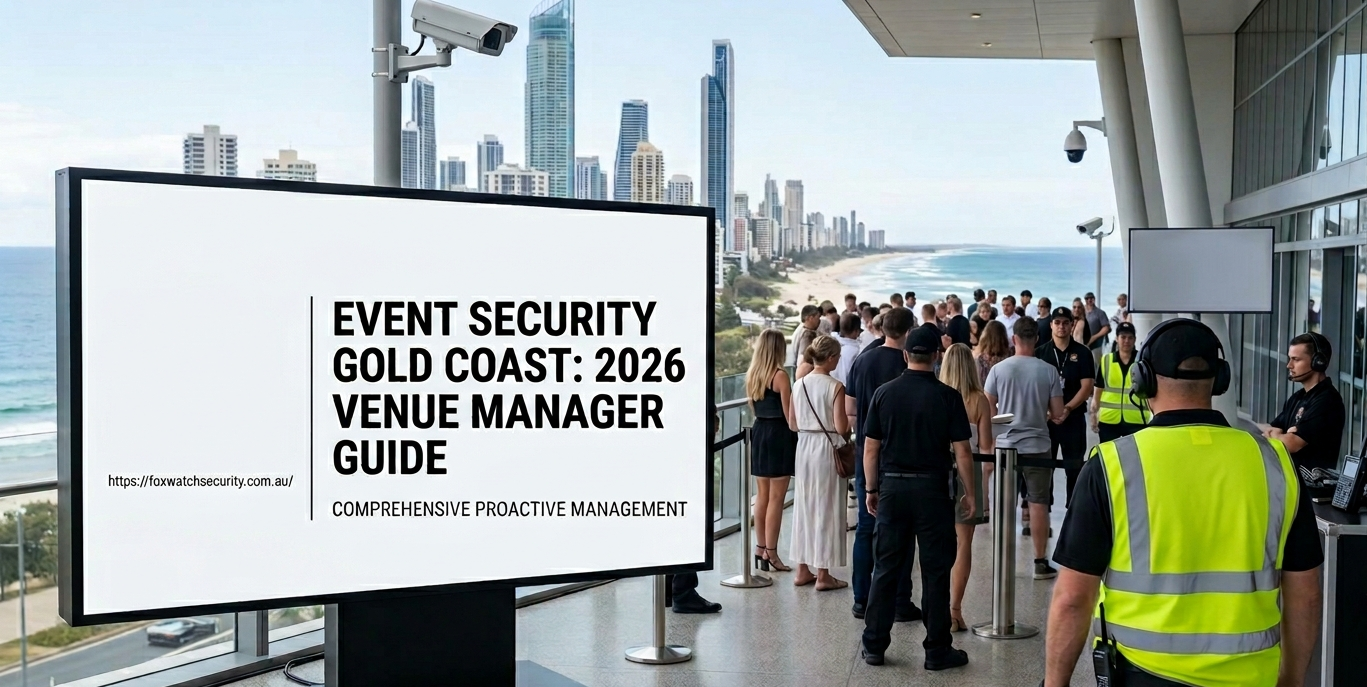
Event Security Gold Coast: 2026 Venue Manager Guide
Let me be straight with you. Most venue managers on the Gold Coast don’t think hard about event security until something goes wrong. A gate-crasher turns nasty. A crowd builds up at one entry point and people start getting pushed. A drunk guest won’t leave and your bar staff have no idea what to do. Then suddenly the phone is out and everyone’s asking why there wasn’t a proper security plan in place.
I’ve seen it happen at small private parties in Burleigh and at large-scale events along the Broadbeach foreshore. The problems are almost always the same — and almost always preventable.
Event Security Gold Coast in 2026 looks different to what it did even three years ago. QLD licensing requirements have tightened. Crowd sizes at major Gold Coast events have bounced back hard post-COVID and kept growing. Venues are being held to a higher standard by insurers and the Office of Liquor and Gaming Regulation. And attendees — especially at ticketed events — genuinely expect a safe environment.
This guide covers what you actually need to know as a venue manager or event organiser. Not just the buzzwords. The real stuff — what services matter, what the law says, how many guards you need, and what to ask before you sign anything.
What Event Security Gold Coast Actually Covers
People use the phrase “event security” to mean a lot of different things. A bouncer at the front door. A hi-vis team walking the perimeter. A close protection detail for a visiting executive. Technically they’re all part of it — but they’re very different in terms of training, licensing requirements, and how they’re deployed.
Real event security management Gold Coast is a coordinated operation. There’s a plan. There’s a command structure. There’s a risk assessment done before anyone sets foot on site. And every person in that operation holds the right Queensland licence for the role they’re performing.
Here’s what that actually looks like in practice.
Event Risk Assessment: The Part Most People Skip
If you take one thing from this entire guide, make it this — get a proper event risk assessment done before you book a single guard.
I know it sounds like admin. But a risk assessment is the document that tells your security team what they’re actually walking into. Without it, you’re paying for guards who’ve been given a venue address and a start time. That’s not a security operation. That’s bodies filling space.
A solid risk assessment for a Gold Coast event should look at:
- How many people are coming and what their demographic is (18th birthday crowd behaves differently to a corporate awards night)
- Every entry and exit point, including the ones people use informally — the side gate near the kitchen dock, the car park that backs onto the neighbouring property
- Where the licensed bar areas are, how long they’re trading, and what RSA protocols are in place
- Queensland summer weather, particularly for outdoor events — heat exhaustion is a real crowd management issue, not a hypothetical
- Any history of incidents at that venue or that type of event
- Whether there are VIPs or public figures attending who need their own security layer
- Public transport access and how the crowd will flow at pack-down — that last 30 minutes after the event closes is often when the most incidents occur
The risk assessment is also the document your insurer wants to see if something goes wrong. It demonstrates due diligence. Without it, your position in any claim is significantly weaker.
Access Control: More Than Checking Tickets
Access control is the part that most people reduce to “someone checking tickets at the gate.” It’s quite a bit more involved than that.
On the Gold Coast, where events range from intimate private functions in private residences to 10,000-person festivals at the foreshore, access control needs to be scaled and layered properly.
The basics: ticket or credential checking at every public entry point, run by guards who know what a fake wristband looks like and who aren’t going to be talked past by someone insisting they’re “on the list.”
The bag checks piece has become standard practice at most public Gold Coast events and a lot of private ones too. Done well, bag checks don’t create long queues or make guests feel like suspects — they’re quick, professional, and efficient. Done badly, they back up your entry for 40 minutes and frustrate every single person before they’ve even stepped inside.
Beyond the front gate, proper access control includes:
- Wristband or credential systems for VIP zones, backstage areas, and production zones
- Vehicle access at load-in points — particularly at venues on the waterfront or in the Broadbeach entertainment precinct, where a confused delivery driver at the wrong entry point can cause real problems
- Monitoring internal flow between zones throughout the event, not just at the start
The detail that gets missed most often: access control doesn’t finish when the doors open. It runs continuously until the venue is empty.
Crowd Control Gold Coast: Reading the Room (and the Crowd)
Crowd control Gold Coast is a specialised skill that goes well beyond standing in front of a crowd and looking imposing.
The Gold Coast crowd profile is genuinely different to other parts of Australia. You’ve got a large international tourist population who may not understand local norms around alcohol or public behaviour. You’ve got a strong backpacker and young adult demographic in the Surfers Paradise and Broadbeach precincts. You’ve got heat — real, physical, Queensland-summer heat — that makes people irritable and dehydrated in ways that increase the likelihood of incidents. And you’ve got venues that are often outdoors or semi-outdoors, which changes how crowd pressure builds and where it goes.
Good crowd management guards are watching for things most people don’t notice. The two blokes who’ve been arguing quietly near the bar for 15 minutes. The section of crowd that’s getting too dense near the stage. The person who’s clearly had too much and is about to become someone else’s problem.
The job is to intervene before those situations become incidents — not after. That’s what separates a good crowd management operation from one that’s just reactive.
FoxWatch Security trains its Gold Coast guards specifically in proactive crowd monitoring, de-escalation, and positioning for both visibility and rapid movement. At venues like Metricon Stadium, the GCCEC, or large outdoor sites at Coolangatta or Coomera, those skills are not optional extras.
Perimeter Security: The Boundary Nobody Watches
This one gets underfunded on almost every event budget. Perimeter security — monitoring and controlling what happens at the outer edges of your event footprint — is the piece that falls apart most easily.
At a typical Gold Coast outdoor event, the perimeter might include:
- A stretch of beach or parkland adjacent to the event site that people can access without going through the front gate
- A car park that connects to a street well away from the main entry
- A shared boundary with another venue or a residential area
- A service lane or fire exit that’s technically locked but can be easily bypassed
Perimeter guards are not glamorous work. They’re walking or stationed at spots that see very little action most of the time. But they’re there for the moments that matter — the group trying to slip in from the back, the person who’s been ejected from the front and is now testing every other entry point they can find, or the situation that’s developing outside the fence line before it becomes your problem inside it.
VIP Protection at Gold Coast Events
The Gold Coast hosts a significant number of events with high-profile attendees — visiting executives, athletes during the Magic Round or Commonwealth Games legacy events, entertainment industry figures, and the occasional political delegation.
VIP protection at this level is a distinct service from general event security. It requires guards with close protection training, advance briefings on the specific threat profile of the person being protected, pre-planned routing through the venue, and an extraction plan for emergencies.
FoxWatch Security provides executive-level protection that’s designed to be invisible to the broader event experience. The goal isn’t to surround a VIP with a wall of people in black shirts — it’s to have the right people in the right positions, briefed properly, so that if something happens the response is immediate and controlled.
Incident Response and Emergency Response: What Happens When Things Go Wrong
Here’s the uncomfortable reality: incidents happen at events. Even well-run ones. The question is not whether your security team will face an incident — it’s whether they know what to do when they do.
Incident response in a professional security operation means:
- A clear chain of communication between guards, the supervisor, and venue management
- Real-time incident logging (not scribbled notes on a clipboard at the end of the night — actual contemporaneous records)
- Direct liaison with Queensland Police Service and Queensland Ambulance Service when required
- A supervisor who has the authority to make decisions without having to call five different people first
Emergency response covers the bigger scenarios — things you hope never happen but absolutely need a written plan for:
- Medical emergencies, including crowd crush situations
- Fire evacuation — particularly important at indoor Gold Coast venues with limited exits
- Severe weather (afternoon thunderstorms during summer events are not rare on the Gold Coast)
- Violent or threatening behaviour that goes beyond a normal ejection
- Lost children — this gets treated as a genuine emergency, not a minor inconvenience
- Security alerts
Every single guard should be briefed on the emergency response plan before the event starts. Not handed a laminated card at the gate. Actually briefed — location of first aid posts, evacuation assembly points, who calls QPS, who calls QAS, who communicates with attendees.
That’s the standard. If your current security provider doesn’t operate at that level, it’s worth asking why not.
Venue Protection: After the Crowd Leaves
Venue protection is the piece that event managers sometimes hand off without much thought — and then regret.
Between bump-in and the event itself, expensive production equipment sits in a venue with multiple entry points and contractors moving in and out. After the event, during pack-down, the same thing happens in reverse, often late at night and with tired, distracted staff.
Overnight security between bump-in and event day is standard practice for any event with significant production value. A single overnight guard protecting a lighting rig worth $80,000 is not an extravagance — it’s basic risk management.
Similarly, pack-down security until the venue has been handed back to the property owner is part of a complete event security operation, not an optional add-on.
Event Security Management Gold Coast: How the Planning Timeline Works
The most common mistake — aside from skipping the risk assessment — is engaging a security provider too late.
Here’s a realistic planning schedule:
8–12 weeks out: Brief your security provider. Share the event runsheet, expected attendance, venue plans, licensing conditions. A good provider asks questions at this stage that will shape the whole security plan.
4–6 weeks out: Risk assessment completed and security plan drafted. For larger events, this goes to Queensland Police Service for liaison. For any event with a liquor licence, it needs to align with your licence conditions.
2–3 weeks out: Guard numbers confirmed. Briefing documents prepared — venue maps, communication protocols, risk areas flagged, incident response procedures documented.
1 week out: Site walkthrough with the security supervisor. Access points physically confirmed, communication dead zones identified (mobile coverage at some outdoor Gold Coast sites is patchy), emergency routes walked.
Event day: Guards on site early enough to be properly briefed before doors open. Supervisor with a live communication channel to venue management throughout.
Post-event: Written debrief from your security provider covering any incidents, observations, and recommendations. This document matters for your insurer and for planning future events at the same or similar venues.
How Many Guards Do You Actually Need?
There’s no magic number, but here’s a practical starting framework for Gold Coast events:
| Event Type | Starting Guide |
| Small private function (under 100 guests) | 1–2 guards minimum |
| Corporate dinner or awards night (100–300 guests) | 2–4 guards |
| Licensed venue event (300–1,000 attendees) | 1 guard per 100–150 attendees |
| Festival or large outdoor event (1,000+) | 1 guard per 75–100 attendees, plus supervisors |
| Events with high alcohol service or elevated risk factors | Add 25–30% to whatever number you calculated |
These are starting points, not final answers. Your actual number will be shaped by the venue layout, the crowd profile, the licensing conditions, and the specific risk factors identified in the assessment.
One thing worth knowing: Queensland’s Liquor Act 1992 and associated regulations impose minimum security staffing requirements for certain licensed events. High-risk venues and events trading late carry additional requirements. A provider who knows QLD licensing law will factor this in automatically — one who doesn’t might leave you non-compliant.
Hire Event Security Gold Coast: What to Actually Ask Before You Sign
When you hire event security Gold Coast, the difference between a good provider and a bad one often isn’t obvious until event day. Here’s what to ask upfront:
Can you show me your Queensland security provider licence and confirm licensing for every guard you’ll deploy? If there’s hesitation on this question, move on. FoxWatch Security deploys only fully licensed QLD personnel — this should be a baseline expectation, not a differentiator.
How many events have you run at this venue or in this precinct? Local knowledge matters. A Gold Coast foreshore event has different operational requirements to a hotel ballroom in Brisbane. The geography, the crowd culture, the late-night precinct dynamics around Surfers Paradise — these things are learned through experience, not read in a manual.
What does your incident reporting look like? You want contemporaneous written records, not a verbal debrief. If something happens at your event, your insurer and potentially a court will want documentation.
Who is the supervisor on the night and what authority do they have? A supervisor who has to call the company director before making a significant decision is not a supervisor in any useful operational sense.
What’s your emergency response protocol? This question should produce a specific, detailed answer. If you get vague reassurances, that’s a problem.
Licensed Security Guards Gold Coast: What the Law Requires in 2026
This section matters. Not because legal compliance is exciting, but because getting it wrong is genuinely costly.
In Queensland, providing event security services requires individual guards to hold a valid security industry licence under the Security Providers Act 1993 (Qld). The licence class matters — crowd controllers have different requirements to general security officers. The OFT enforces this, and penalties apply to both the security company and the event organiser who engages unlicensed workers.
Compliance in 2026 also includes:
- Ongoing training requirements that guards must meet for licence renewal
- RSA (Responsible Service of Alcohol) interaction requirements for guards working at licensed events under the Liquor Act 1992 (Qld)
- Duty of care obligations under common law that extend directly to the event organiser — not just to the security company
That last point is important. As a venue manager or event organiser, you can’t transfer your legal duty of care to your security provider. If you failed to conduct a reasonable risk assessment, or if you knowingly engaged unlicensed personnel, you carry personal exposure.
FoxWatch Security operates as a licensed security provider under Queensland law — not a labour hire agency putting warm bodies in high-vis. That distinction is worth understanding before you sign any contract.
Security for Events Near Me: Why Local Presence Actually Matters
When you search security for events near me or event security services near me from the Gold Coast, you’ll get a broad mix of results. Interstate providers. Companies that handle the administration from Brisbane or Sydney and subcontract locally. And genuinely local operators who have teams based on the Gold Coast and operational knowledge of the specific venues and precincts.
The difference shows up in a few specific ways:
Response times. If you need additional guards at short notice during the event, or if something happens and you need rapid reinforcement, a company whose nearest team is 90 minutes away is not going to help you.
Venue familiarity. Guards who have worked at the GCCEC before know where the service corridors are, where mobile coverage drops out, which entry points fill up fastest on arrival, and where the QPS liaison point is. That knowledge isn’t trivial.
Local QPS relationships. For larger events, the relationship between your security supervisor and the local Queensland Police Service contact matters. It’s built event by event, over time, in the same geographic area.
FoxWatch Security operates across the Gold Coast — Surfers Paradise, Broadbeach, Southport, Robina, Coomera, Coolangatta, and surrounding areas. Their guards are based locally and briefed on the specific venues and environments they’re working in.
Private Party Security on the Gold Coast
A lot of people assume private events don’t need the same level of security as public ones. It’s a common assumption and it’s often wrong.
Private parties — house parties, private function hire, birthday celebrations, family events — come with their own specific risks:
Gate-crashers. At a residential property or a private venue hire, word can get out quickly. By 10pm a private party of 60 people can become an event of 150, with a significant number of people who were never invited and who have no relationship with the host.
No RSA framework. Licensed venues have RSA-trained staff and licence conditions that create some structure around alcohol service. Private events often don’t. When things go wrong, there’s no framework — just whoever’s hosting and whoever’s getting out of control.
Limited staff. At a private party, the people “running” the event are usually the host’s friends or family. They’re not security professionals and shouldn’t be expected to manage a difficult situation.
FoxWatch Security provides private event security across the Gold Coast. A professional team for a private function doesn’t need to look or feel like a club entry — it can be low-profile and unobtrusive while still providing genuine protection.
What a Professional Gold Coast Security Guard Team Looks Like on the Day
For the benefit of venue managers who haven’t worked with a professional gold coast security guard team before, here’s what a properly structured deployment actually looks like:
A security supervisor who runs the operation, communicates directly with venue management, and makes real-time decisions. Not a senior guard who’s also manning a door. A dedicated supervisor.
Entry guards handling every public access point — ticket checking, credential checking, bag checks, wristband issue. The number depends on how many entry points the venue has and the expected arrival flow.
Floor or roving guards who move through the venue continuously, monitoring crowd density and behaviour, identifying tension before it escalates, and managing the internal flow of the event.
Perimeter guards at the boundaries of the event footprint — less visible but genuinely important.
A communication setup that actually works — radios or earpieces, clear channel allocation, a protocol for escalating different levels of incident to the supervisor and to venue management.
Before any of this starts, every guard on site has been briefed on the venue map, the specific risk areas identified in the assessment, the incident response protocol, and the emergency evacuation plan.
That’s the standard. That’s what you’re paying for when you engage a professional event security service.
The Difference Between Event Security and Crowd Control
This question comes up regularly so it’s worth addressing directly.
Event security is the whole operation — every protective function across the entire event, from before gates open until the venue is clear. Access control, VIP protection, incident response, perimeter management, venue protection, and emergency planning all sit within event security.
Crowd control is one specific function within that operation — managing the physical movement and behaviour of large groups of people. It includes managing queue behaviour, directing crowd flow, managing density in specific areas, and intervening when a crowd situation becomes dangerous.
Every crowd controller in Queensland must hold the specific crowd controller licence class under the Security Providers Act 1993 (Qld). The training and certification requirements are distinct from those for general security officers.
In practice, for most Gold Coast events you need both. Crowd management is delivered as part of the broader event security framework — not as a separate service bolted on at the last minute.
Final Thoughts on Event Security Gold Coast in 2026
The Gold Coast’s events calendar is busy and getting busier. Venues are under more scrutiny than ever — from attendees who expect a safe experience, from insurers who want to see documented risk management, and from the QLD regulatory environment that has real teeth when things aren’t done properly.
Event Security Gold Coast done well isn’t visible. The crowd flows. Entry is smooth. The odd difficult situation gets handled quietly before it becomes a problem. The event ends and the venue is handed back in good shape. That’s the outcome a professional security operation delivers.
Done badly — or not done at all — the consequences range from ruined events to insurance claims to personal legal exposure for the organiser.
FoxWatch Security has the Gold Coast knowledge, the QLD-licensed personnel, and the operational depth to handle events from small private functions through to large-scale public gatherings. If you’re planning an event and haven’t sorted your security plan yet, it’s worth having that conversation sooner rather than later.
Frequently Asked Questions (FAQs)
Q1: What does event security include on the Gold Coast?
It covers access control, bag checks, crowd management, perimeter security, VIP protection, incident response, and emergency planning — all delivered by QLD-licensed security guards.
Q2: Why do I need event security guards for my Gold Coast event?
Licensed guards manage crowd behaviour, reduce incident risk, ensure QLD legal compliance, and provide documented incident response — protecting your attendees, your venue, and your liability.
Q3: How many security guards do I need for an event?
A rough guide is one guard per 100–150 attendees. High-risk or licensed events need more. Your provider calculates the exact number after a proper site risk assessment.
Q4: What is the difference between event security and crowd control?
Event security covers all protective functions across a venue. Crowd control is a specific subset — managing crowd movement and density. Both need licensed Queensland security personnel.
Q5: Can I hire event security for private parties on the Gold Coast?
Yes. FoxWatch Security provides scalable private party security on the Gold Coast — managing gate-crashers, access control, and on-site incidents for functions of any size.
FoxWatch Security — Event Security Services Gold Coast | foxwatchsecurity.com.au
Comments are closed