
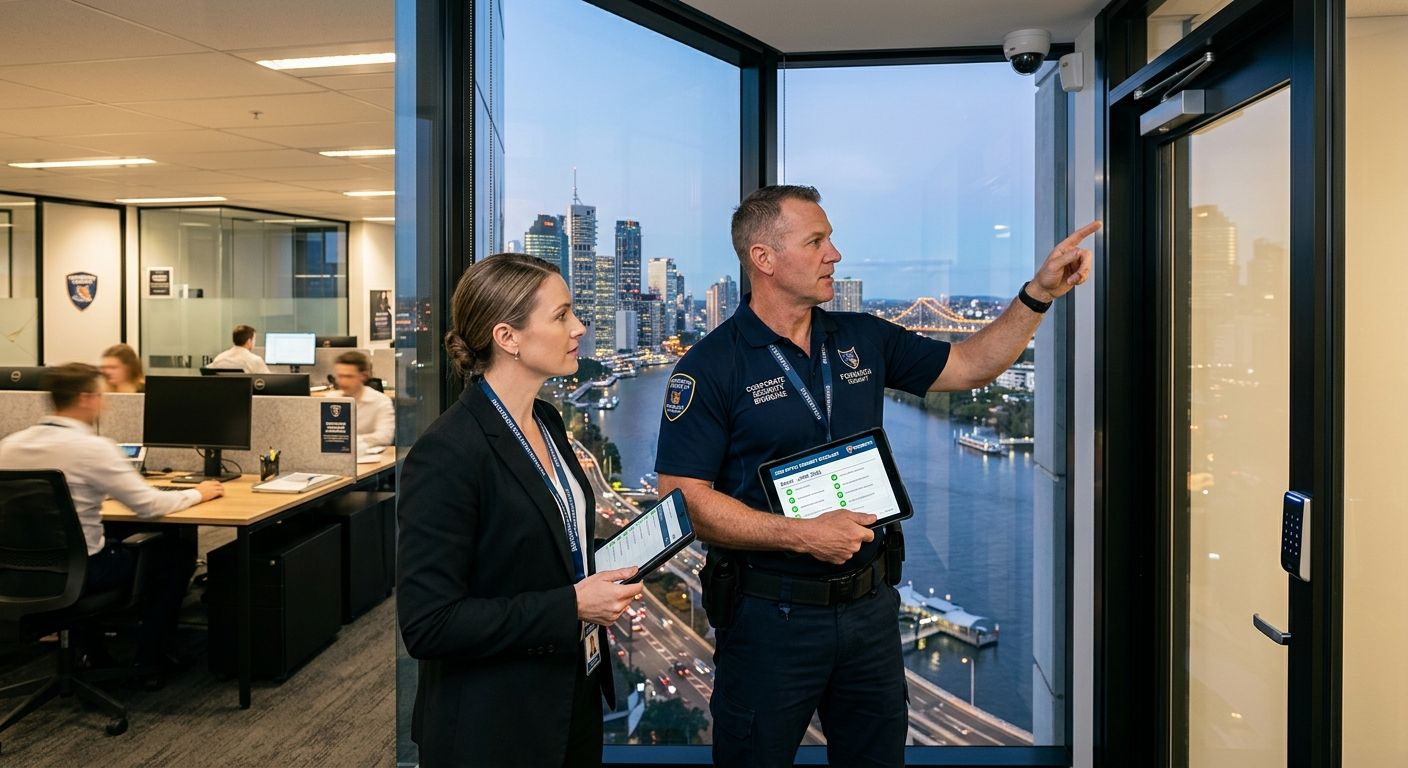
Corporate Security Brisbane 2026 is not the same job it was even two years ago, and if you run an office anywhere from the CBD to Eagle Farm, that shift is already affecting you — whether you’ve noticed it or not.
Here’s the uncomfortable truth most Brisbane business owners don’t want to hear: the security setup you signed off on when you moved into your premises is almost certainly out of date. Staff have come and gone. Fitouts have changed. That swipe card system the previous tenant installed still has old credentials floating around in it. And the city itself is changing fast — Brisbane is mid-transformation ahead of the 2032 Olympics, with new towers, new precincts, and a lot more foot traffic moving through commercial districts than there was five years ago.
So this isn’t a generic “lock your doors” article. It’s a practical, Brisbane-specific office checklist you can actually work through — the kind a proper corporate security team would walk your building with. Grab a coffee, print it if you like, and let’s find the gaps before someone else does.
Why Corporate Security Brisbane 2026 Deserves a Fresh Look
Let’s skip the scary statistics and talk about what’s actually changed on the ground.
Brisbane is building at pace. The lead-up to 2032 has commercial construction humming across Fortitude Valley, Newstead, South Brisbane and the CBD fringe. New buildings mean new tenancies, temporary construction access, and a lot of contractors moving in and out of half-finished floors. That’s a genuine access control headache, and it’s one most businesses don’t plan for until something goes missing.
Tenancy turnover has left a mess behind it. Offices change hands constantly. When they do, old access credentials rarely get properly cleaned out. Keys, fobs, alarm codes — a surprising number of Brisbane offices are running on a system where nobody can confidently say who currently has access. That’s not a hardware problem. It’s an admin problem, and it’s exactly the kind of thing a proper business security audit drags into the light.
The weather is a security factor here, and people forget that. Brisbane’s storm season and the very real flood risk along the river corridor aren’t just facilities issues — they’re security ones. Power outages knock out cameras and electronic locks. Flooding forces evacuations that leave premises exposed. Any serious plan for commercial security Brisbane businesses rely on has to account for what happens when the grid drops and the doors default to unlocked.
None of this is a reason to panic. It’s a reason to work through the checklist below with honest eyes.
The 2026 Office Security Checklist for Brisbane Businesses
Think of this as a commercial property security checklist you can run against your own premises today. It’s broken into the areas Brisbane offices most often get wrong. Be honest with each point — the value is in the gaps you find, not the boxes you tick.
1. Office Perimeter Security: Start at the Edges
Most break-ins don’t start at the front door. They start at the point nobody’s watching.
Your office perimeter security is the first layer, and in Brisbane’s older commercial stock — think the converted warehouses around Newstead and West End — it’s frequently the weakest. Rear laneways, loading docks, side gates, and roller doors are the usual culprits.
- [ ] Every external door has a quality deadbolt or functioning electronic lock — including the ones “nobody uses”
- [ ] Rear and side access points are lit at night with no dead zones (Brisbane’s humid summers grow foliage fast — that hedge is now a hiding spot)
- [ ] Roller doors and loading bays are secured and monitored, not just pulled down
- [ ] Ground-floor and basement windows have appropriate glazing or bars where exposed
- [ ] Fence lines and yard boundaries are intact and not obscured by parked vehicles or stored stock
2. Access Control Systems for Commercial Buildings
This is where 2026 really separates the prepared from the exposed. Access control systems for commercial buildings have moved well beyond a lockbox and a signout sheet, and if yours hasn’t, that’s your first fix.
- [ ] You have a current, written list of every person holding a key, fob, or access card
- [ ] Credentials are revoked immediately when staff leave — not “when we get around to it”
- [ ] Access is role-based; not everyone can enter the server room, the finance area, or the store room
- [ ] Contractor and cleaner access is time-limited and logged, not a permanent open door
- [ ] Master keys and admin codes are held by named, accountable people
- [ ] The system produces an audit trail you can actually review after an incident
If you can’t confidently confirm who currently has access to your office, that’s the single most important line item on this entire checklist.
3. Office Security Systems Brisbane: Cameras, Alarms and Monitoring
Cameras that record but are never watched aren’t security — they’re expensive hindsight. The right office security systems Brisbane businesses need in 2026 are integrated, monitored, and actually maintained.
- [ ] All CCTV cameras are operational and positioned to identify faces, not just “capture movement”
- [ ] Someone has physically walked every camera’s coverage to confirm there are no blind spots (fitouts move furniture; furniture creates gaps)
- [ ] Footage is stored securely with enough retention to be useful after a delayed-discovery incident
- [ ] Your alarm system has been tested in the last six months — not just assumed to work
- [ ] Alarm monitoring is linked to a real response service, not just a siren nobody responds to
- [ ] Signage advises CCTV is in operation (a requirement under Queensland privacy expectations, and a proven deterrent)
A siren going off at 2am in an empty Milton office park does nothing on its own. Pairing your alarm with a dedicated alarm response service is what turns a noise into an actual intervention.
4. Physical Security Measures for Offices: The Internal Layer
Once you’re past the perimeter, the internal layer is what protects your people and your sensitive assets. Strong physical security measures for offices assume that someone will eventually get inside — and limit what they can reach when they do.
- [ ] Server rooms and comms cabinets are in separately locked areas, not the general office
- [ ] Sensitive documents (contracts, client files, HR records) are locked away after hours
- [ ] A clean-desk policy is enforced where confidential information is handled
- [ ] Reception controls the flow of visitors rather than letting people wander through
- [ ] Cash-handling areas are secured and out of public sightlines
For Brisbane businesses that move cash — hospitality, retail head offices, medical practices — reducing what’s held on site is one of the smartest moves you can make. A cash-in-transit arrangement takes that target off your premises entirely.
5. Visitor and Contractor Management
A paper signin book that gets checked when the receptionist happens to look up is not visitor management. It’s a record created after the person is already inside.
- [ ] Every visitor is signed in and out, every time — ideally through an electronic system
- [ ] Visitors are escorted or restricted to appropriate areas, not handed a free run of the floor
- [ ] Contractors have a defined access protocol: who approved them, where they can go, when their access ends
- [ ] Deliveries are received at a controlled point, not left at an unattended dock
6. People, Process and the After-Hours Reality
The best hardware in Brisbane fails if your team doesn’t know how to use it. Half of solid corporate asset protection is simply people knowing what to do.
- [ ] Staff have been briefed on tailgating and know it’s okay to challenge an unfamiliar face
- [ ] Everyone knows the alarm and lockup procedure — and it’s written down, not folklore
- [ ] There’s a current after-hours contact list for senior staff
- [ ] After-hours risk is covered by mobile patrol at irregular intervals (predictable patrols are easy to work around — the randomness is the point)
- [ ] A review date is in the calendar before this checklist gets filed away
Brisbane Business Security Solutions: Matching the Fix to the Precinct
One mistake I see constantly is treating Brisbane as one uniform place. It isn’t. The right brisbane business security solutions shift depending on where you actually are.
CBD and Spring Hill high-rises. The threat here isn’t a smashed window — it’s access. Tailgating into lift lobbies, piggyback entry, and opportunistic theft in shared common areas. In multi-tenanted towers, nobody’s ever quite sure whether building management or the tenant owns the stairwell and basement risk. Nail down that boundary.
Fortitude Valley, Newstead and Teneriffe. Creative agencies, tech firms and professional services in older converted buildings. Great character, dated back-of-house security. Rear-lane access and roller doors are the recurring weak points.
South Brisbane and West End. Rapid commercial growth, mixed-use buildings, and heavy nightlife foot traffic nearby. After-hours exposure is the theme.
Milton and Toowong. Office parks and standalone buildings with no shared lobby to fall back on — the security responsibility sits entirely with you.
Eagle Farm, Australia TradeCoast and the industrial east. A completely different profile: perimeter fencing, yard lighting, vehicle access and cargo integrity. Industrial security here is about scale and movement, not just locked doors. Our broader commercial security services are built for exactly these environments.
What Corporate Security Guards Brisbane Businesses Actually Get
Technology has limits. A camera can’t approach a suspicious person, and an alarm can’t de-escalate a tense situation in your lobby. That’s the case for a human layer.
Well-deployed corporate security guards Brisbane businesses trust do four things technology can’t: they assess, they respond, they de-escalate, and they document — often all at once. A licensed guard on site is the most flexible security resource you can have, which is why our security guards in Brisbane are so often the backbone of a corporate arrangement rather than an add-on.
For offices that don’t need a full-time presence, mobile patrol fills the gap cost-effectively — scheduled and randomised visits that check your access points, spot anomalies, and keep a visible deterrent in play after everyone’s gone home.
Smart Commercial Security Trends 2026 Worth Watching
If you’re planning a refresh this year, these are the smart commercial security trends 2026 actually shaping the market — not the hype, the useful part.
Integration over accumulation. The shift isn’t toward more devices; it’s toward systems that talk to each other. Access control, CCTV and alarms feeding one dashboard beats three disconnected products every time.
Cloud-based access with remote revocation. Being able to kill a departed employee’s access from your phone, instantly, closes the single most common gap in Brisbane offices.
AI-assisted video analytics. Cameras that flag loitering or after-hours movement rather than passively recording. Useful — but only if a real response sits behind the alert.
Verified alarm response. Insurers and clients increasingly want proof that an alarm leads to a person attending, with a documented response time. Verbal assurance is losing ground to evidence.
Resilience against outages. Given Brisbane’s storm season, battery backup and fail-secure locking (doors that lock, not unlock, on power loss) are moving from nice-to-have to standard.
A Word on Licensing — Because in Queensland It’s the Law
Any provider you engage for corporate security Brisbane 2026 work must be properly licensed. In Queensland, security firms and individual guards are regulated under the Security Providers Act 2003, administered by the Office of Fair Trading. This isn’t paperwork trivia — it’s your protection.
Ask any provider for their licence details before you sign anything. A credible security company Brisbane businesses can rely on will hand that over without hesitation. Any hesitation is your answer. You can see FoxWatch Security’s licences and certifications laid out plainly, exactly as they should be.
The Real Cost of Skipping the Checklist
Here’s the arithmetic Brisbane business owners tend to avoid. A single office break-in rarely costs just the value of what’s taken. Add the repair, the insurance excess, the downtime, the data exposure if a laptop or file walked out the door, the staff disruption, and — often the biggest number — the client confidence you lose if word gets out.
Running a proper office security checklist, and then a genuine business security audit on the gaps it surfaces, costs a fraction of one incident it prevents. That’s not a sales line. It’s just maths.
Your Next Move on Corporate Security Brisbane 2026
Work through the checklist above honestly. Be specific — “the CCTV has gaps” is useless; “camera 3 doesn’t cover the rear fire exit, which is our main after-hours door” is something you can fix. Prioritise the credential audit and the after-hours coverage first, because those are where Brisbane offices are most exposed heading into 2026.
Then, if you want a licensed, local team to walk your premises and give you a clear-eyed picture of where you actually stand, that’s exactly what we do. Learn more about our Brisbane operations, or get in touch and we’ll help you turn this checklist into a plan.
Security isn’t a one-time project. It’s a habit — and 2026 is a good year to build a better one.
Frequently Asked Questions
Q1: What should a Corporate Security Brisbane 2026 office checklist cover first?
Start with your access credentials and after-hours coverage. Audit who holds keys, fobs and codes, revoke old ones, then confirm your alarm has a real response behind it.
Q2: How often should Brisbane businesses run a business security audit?
At least once a year, and immediately after any move, staff change, fitout, or incident. Environments shift fast in Brisbane — an audit older than 12 months is likely out of date.
Q3: Do small Brisbane offices really need corporate security guards?
Not always full-time. Many use mobile patrol and alarm response for cost-effective after-hours cover, then scale up to on-site guards only where the risk profile genuinely calls for it.
Q4: What access control systems suit commercial buildings in 2026?
Cloud-based, role-based systems with remote revocation and an audit trail. They let you cut a departed employee’s access instantly — closing the most common gap in Brisbane offices.
Q5: What licence must a security company in Brisbane hold?
A current Queensland security licence under the Security Providers Act 2003, for both the firm and each guard. Ask for documentation upfront — any reputable provider supplies it immediately.
Comments are closed