
5 Melbourne Security Gaps Every Commercial Property Faces in 2026
Commercial Security Melbourne 2026 is no longer a “set and forget” box you tick once a year. If you’re running a warehouse in Dandenong, a retail strip in Chadstone, an office tower in the CBD, or a logistics hub out near Tullamarine, the threat picture has shifted under your feet over the last 12 months. Break-ins are getting bolder, opportunistic theft is up, and insurers are starting to ask hard questions before they’ll sign anything off.
The frustrating part? Most Melbourne businesses already think they’re covered. They’ve got cameras. They’ve got an alarm. Maybe a guy who drives past at 2 a.m. on weekends. But when we walk through their sites, the same gaps keep showing up — and these are the gaps criminals in Melbourne are actively exploiting in 2026.
Let’s break down the five biggest ones, what they actually cost you, and the fixes that hold up in the real world.
Why Commercial Security Melbourne 2026 Looks Nothing Like 2022
Before we dig into the gaps, it’s worth understanding why the goalposts have moved.
Three things have changed for Melbourne commercial properties this year:
- Organised retail crime has become coordinated. It’s not lone shoplifters anymore — it’s small crews hitting multiple sites in a single night across the western and northern suburbs.
- Insurance premiums for commercial property have climbed sharply, and underwriters are now demanding evidence of layered security, not just a sticker on the front door.
- Hybrid work has left half-empty buildings overnight, which means longer windows of vulnerability and far fewer staff to notice when something’s off.
That’s the backdrop. Now to the gaps.
Gap #1: Relying on Cameras Without Anyone Actually Watching Them
This is the most common mistake we see in commercial security Melbourne sites — beautiful 4K camera systems recording flawlessly to a hard drive that nobody checks until after something’s been pinched.
CCTV on its own is forensic. It tells you what happened yesterday. It does not stop what’s happening right now.
In 2026, the businesses pulling ahead are pairing footage with live surveillance & monitoring services Melbourne so eyes are on the feed in real time. The moment a fence line is crossed at 11 p.m., a monitoring operator sees it and dispatches a unit — they’re not waiting for the morning shift to spot a smashed door.
The fix: Connect your existing camera infrastructure to a 24/7 monitoring desk and tie it directly to alarm response services Melbourne. One without the other is half a system.
Gap #2: A Security Plan That Stops at the Front Door
Walk into ten Melbourne commercial properties and nine of them will have hardened the front entrance and completely forgotten about everything else. Loading docks left ajar. Side gates with rusted padlocks. Roller doors that haven’t been pressure-tested since the building went up.
For warehouses and distribution centres especially — and we see this constantly across the south-east industrial corridor — the back of the property is where the real exposure sits.
A proper commercial security solutions approach treats the site as a perimeter, not a doorway. That means:
- Layered access control on every entry point, not just reception
- Mobile sweeps that cover the rear of the building, not just the carpark
- Sensor coverage on roof access and skylights (yes, this is happening more in 2026)
If your current provider hasn’t done a full perimeter walk with you in the last six months, that’s your sign. Have a look at how proper industrial security Melbourne coverage is structured if you want a benchmark.
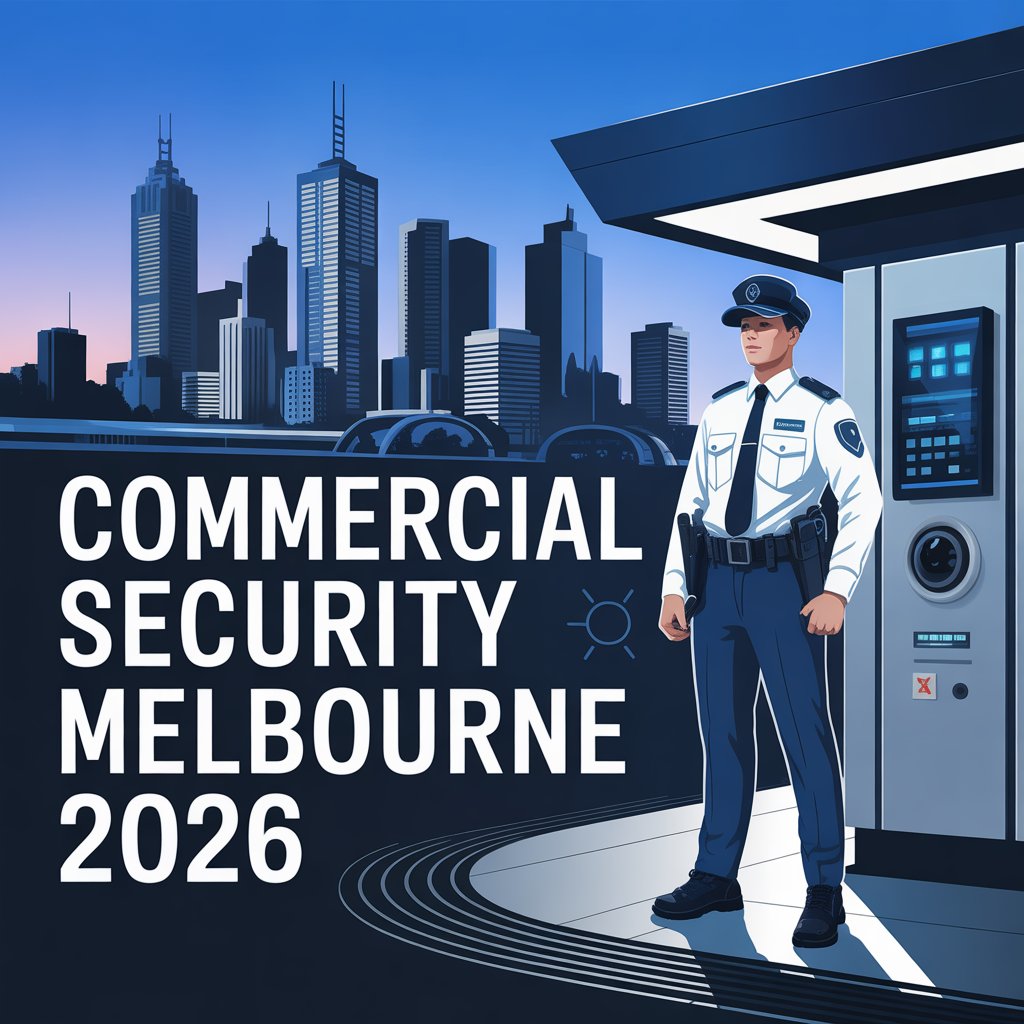
Gap #3: No Human Presence During the Highest-Risk Windows
Here’s the uncomfortable truth most Melbourne business security setups won’t say out loud: technology alone doesn’t deter a determined offender. A camera doesn’t make someone hesitate. A uniformed guard does.
The data backs it up. Sites with visible security guards Melbourne report dramatically lower incident rates than sites running on pure tech. Why? Because most opportunistic crime is exactly that — opportunistic. The presence of a licensed officer on-site shifts the calculation in the offender’s head before they even commit.
For Melbourne commercial properties in 2026, the highest-risk windows are usually:
- 11 p.m. to 4 a.m. on weeknights
- All day Sunday
- Public holiday long weekends, especially the four-day Easter and Christmas windows
These are the hours where having actual on-site security personnel Melbourne — not just a contract that says someone might drive past — makes the difference between a quiet morning and a five-figure insurance claim.
Gap #4: Patchy Coverage Between Static Guards and Mobile Patrols
A lot of Melbourne businesses pick one or the other. They either lock in a static guard for set hours, or they go with mobile patrol services Melbourne and call it a day.
Both have weaknesses on their own.
A static guard covers one position brilliantly but can’t check the rear loading bay at the same time. A mobile patrol covers ground but is gone for 23.5 hours of the day. The 2026 standard for commercial security services Melbourne is hybrid coverage — guards on the most exposed positions, with security patrol services Australia sweeping the broader site on randomised intervals.
Randomised is the keyword there. If your patrols arrive at exactly 10 p.m., 1 a.m., and 4 a.m. every single night, anyone watching your site for a week knows your schedule better than you do.
Gap #5: Treating Events, Retail, and Corporate Risk as the Same Problem
This one’s subtle but it costs Melbourne businesses real money. Different commercial environments need genuinely different security approaches, and one-size-fits-all contracts almost always leave the most vulnerable site under-covered.
A few quick examples from the ground in Melbourne this year:
- A boutique on Chapel Street needs retail security Melbourne trained in [retail loss prevention security] — soft-spoken, brand-aligned, watching for organised crews not lone shoplifters.
- A construction site in Footscray needs hi-vis officers who can manage contractor access and after-hours material theft.
- A pop-up activation at Federation Square needs proper event security Melbourne trained in [crowd control and event safety services] and emergency egress, not the same officer you’d put at a warehouse gate.
- A C-suite in a CBD tower needs corporate security Melbourne with discretion, professional dress, and threat awareness — not a generic gate guard.
The fix here is choosing a melbourne security company that actually segments its officers by sector and trains them for the environment, not one that flips the same person between a building site and a corporate boardroom.
What “Good” Looks Like for Commercial Security Melbourne 2026
If you take one thing from this article, make it this: the bar has moved. Commercial Security Melbourne 2026 is now a layered, integrated, accountable service — not a single product.
A solid setup for any commercial property in Melbourne this year should include:
- Licensed, vetted personnel — only licensed security guards Australia with current Victorian credentials and documented training
- Live monitoring tied to rapid alarm response services Melbourne, not just recording
- Hybrid patrol coverage mixing static and mobile so there are no dead hours
- Sector-specific officers trained for your actual environment — retail, industrial, corporate, or events
- Documented access control security Melbourne with audit trails for every entry
- Round-the-clock availability — proper 24/7 security Melbourne means real humans answer the phone at 3 a.m.
- Proper [corporate risk management security] assessments revisited at least every six months
That’s what proper [business asset protection services] and [workplace safety & protection services] look like in 2026 — and it’s what underwriters, insurers, and increasingly your own staff expect.
Closing the Gaps Before Someone Else Does
Every gap in this article is fixable. None of them require ripping out your existing system or doubling your security budget. They require an honest audit, a properly built plan, and a provider that understands Melbourne specifically — not a national franchise running the same playbook from Perth to Penrith.
If your current setup hits two or more of the gaps above, you’re carrying more risk than you should be in 2026. Get a fresh set of eyes on the site, walk the perimeter at night, and benchmark what you’ve got against what your industry actually needs.
The businesses that close these gaps early in 2026 are the ones who won’t be filing claims, replacing inventory, or explaining incidents to head office in 2027.
Frequently Asked Questions
Q1: What is the biggest security risk for commercial properties in Melbourne in 2026?
The biggest risk is unmonitored CCTV — recording without live oversight. Combine cameras with real-time monitoring and rapid alarm response for full coverage.
Q2: Are mobile patrols enough to secure a commercial property?
Mobile patrols alone leave large time gaps. Hybrid cover combining static guards and randomised mobile sweeps gives Melbourne commercial sites the strongest protection.
Q3: Do I legally need licensed security guards in Victoria?
Yes. Victorian law requires all security personnel to hold a current, valid licence. Always verify your provider uses fully licensed guards before signing any contract.
Q4: How often should a commercial security plan be reviewed in Melbourne?
Review your plan every six months minimum, or after any incident, site change, or staff turnover. Threats evolve quickly across Melbourne suburbs in 2026.
Q5: What’s the difference between corporate security and retail security in Melbourne?
Corporate security focuses on executives, access control, and discretion. Retail security focuses on loss prevention, customer-facing presence, and shrinkage reduction.
Ready to close the gaps in your commercial property’s security? Get in touch with Fox Watch Security for a Melbourne-specific site assessment.
Comments are closed