
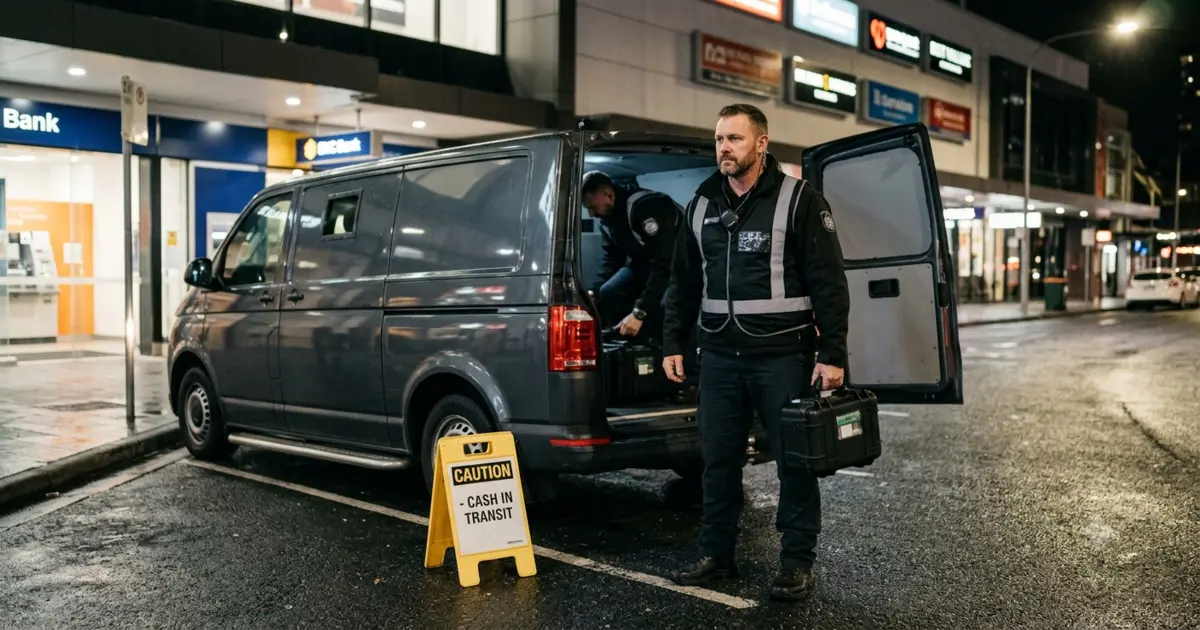
Cash-in-Transit Australia: 2026 Security Standards
Cash in transit Australia has never been a “set and forget” arrangement, and 2026 is proving that point again. Between updated WHS codes of practice, tighter insurance conditions, and a string of attempted robberies reported across the eastern states this year, businesses that move physical cash are under more scrutiny than ever. If your business still handles banking runs, till reconciliations, or ATM top-ups without a documented plan, this is the year that catches up with you.
This guide breaks down what “compliant” actually looks like in 2026, where most Australian businesses are falling short, and how cash in transit services from a licensed provider close the gap. We’ll also cover the regional realities of running cash logistics in Brisbane, the Gold Coast and Melbourne, since a security plan that works for a CBD retail strip rarely suits an outer-suburb industrial estate.
Why Cash in Transit Australia Rules Are Getting Stricter
Robbery hasn’t gone away just because tap-and-go has become the default. Retail, hospitality, aged care, and community organisations still generate physical cash daily — float top-ups, coin collections, church and club takings, market stalls — and every one of those movements is a moment of exposure. Regulators know this, which is why cash-in-transit remains one of the few industries with its own dedicated codes of practice under work health and safety law.
Three things are pushing standards higher this year:
- Reviewed codes of practice. States including NSW have been actively reviewing their cash-in-transit codes to reflect current work practices, vehicle types and technology, replacing guidance that in some cases dated back over a decade.
- Insurer pressure. Business insurance policies increasingly ask for evidence of a documented cash handling risk assessment before they’ll cover cash-related losses, not just a general security policy.
- Duty of care obligations. Officers and directors carry personal due diligence duties under the WHS Act, meaning “we’ve always done it this way” is no longer a defence if a worker is hurt during a cash run.
None of this means small businesses need an armoured convoy. It means the plan you have — even if it’s one staff member walking cash to the bank — needs to be risk-assessed, documented and reviewed.
What the Cash in Transit Code of Practice Actually Covers
The cash in transit code of practice sits under the broader Safe Work Australia framework, alongside guidance such as the General Guide for Managing Cash-in-Transit Security Risks and the Guide for Handling and Transporting Cash. Together, these documents set out who carries WHS duties, how risks should be assessed, and what controls are expected at each stage of a cash movement.
Key obligations spelled out in safe work Australia cash in transit guidance include:
- Identifying and assessing robbery-related hazards before cash ever leaves the premises
- Varying delivery routes and times so patterns can’t be predicted and targeted
- Limiting the amount of cash held or carried at any one point through cash-limit policies
- Training staff in duress procedures, including what to do — and not do — during a hold-up
- Reporting notifiable incidents in line with WHS incident notification requirements
A code of practice isn’t just a nice-to-have PDF sitting in a compliance folder. Courts can treat it as evidence of what a “reasonably practicable” standard of safety looks like, and WHS inspectors can cite it directly in improvement or prohibition notices. That’s a meaningful reason to move cash handling out of informal habit and into a written procedure.
Cash in Transit Regulations Australia: Who Actually Carries the Duty
A common misconception is that cash in transit regulations Australia-wide only apply to armoured car operators. In reality, WHS duties extend to any business whose workers handle or transport cash — including the business using an external provider, not just the provider itself.
That means a retail manager sending a junior staff member to the bank with the day’s takings is still a duty holder under WHS law. If that business hasn’t assessed the route, the timing, or the amount of cash being carried, it’s exposed regardless of whether an external cash-in-transit company is involved elsewhere in its operations.
This is exactly why outsourcing high-risk cash movements to licensed security guard and cash-in-transit specialists is such a common risk-transfer decision for retailers, clubs, medical centres, and franchise groups across Queensland and Victoria.
Armed Cash Transport Australia vs Covert Cash in Transit
Not every cash movement calls for the same level of visible protection, and this is where a good provider should be advising you rather than just quoting a price.
Armed cash transport Australia operations — visible, uniformed guards, marked or armoured vehicles, firearms licensed under state legislation — suit high-value, high-frequency movements such as major retail precincts, banking hubs, and gaming venues where deterrence is the priority. The presence itself discourages opportunistic crime.
Covert cash in transit, by contrast, relies on unmarked vehicles and non-uniformed personnel to move cash without drawing attention. It’s often the better fit for smaller, more frequent transfers where a visible security presence would actually flag “there’s cash here” to anyone watching. Community organisations, small retail chains and hospitality venues often prefer this lower-profile approach for day-to-day banking runs.
The right answer usually isn’t “armed” or “covert” — it’s a mix, decided by a proper cash handling risk assessment of your specific sites, volumes and routes.
Cash Handling Risk Assessment: Where Most Businesses Get It Wrong
A cash handling risk assessment is the foundation the entire code of practice is built on, yet it’s the step businesses skip most often — usually because it sounds more technical than it is.
At a minimum, a proper assessment should look at:
- Cash build-up on site — how much cash accumulates between collections, and whether cash-limit policies are actually enforced
- Timing and route predictability — whether banking runs happen at the same time, via the same path, every single day
- Physical environment — lighting, sightlines, parking proximity, and whether staff are exposed while carrying cash between the building and a vehicle
- Manual handling hazards — cash bags and coin are heavier than people expect, and lifting injuries are a genuine WHS notifiable-incident category in this industry
- Staff training and duress response — whether workers actually know the post-hold-up procedure, not just whether a policy document exists somewhere
If your last risk assessment was a verbal chat rather than a written document with dated review points, it won’t stand up if WHS or an insurer ever asks to see it.
Choosing Cash in Transit Companies Australia Businesses Can Rely On
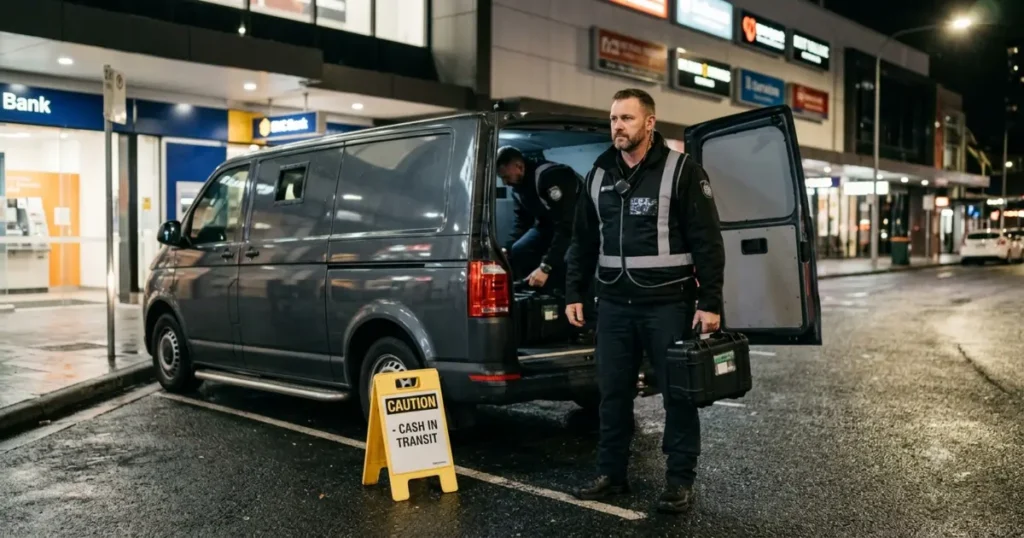
With cash in transit companies Australia-wide ranging from single-vehicle operators to national logistics firms, the selection criteria shouldn’t start with price. It should start with licensing and accountability.
Before signing with any cash-in-transit service, confirm:
- The provider and its individual officers hold current state security licences
- Guards carrying firearms are licensed under the relevant Firearms Act
- The company can produce evidence of insurance covering cash-in-transit liability specifically, not just general public liability
- There’s a documented, auditable process for collection, transport, counting, and deposit — not a verbal assurance
- Local reviews and an established operating history in your region back up the sales pitch
A cash handling and cash-in-transit provider that can’t produce this paperwork on request isn’t one to trust with your daily takings.
Cash in Transit Security Brisbane, Gold Coast and Melbourne: Regional Realities
Cash in transit security Brisbane operators deal with a dense mix of CBD retail, hospitality strips, and rapidly growing outer suburbs — meaning route variation matters as much in South Bank as it does in Ipswich. Cash in transit security Gold Coast businesses face a similar challenge along the tourist corridor, where seasonal foot traffic spikes cash volumes at hospitality and entertainment venues through peak periods.
Melbourne’s spread-out retail and industrial precincts bring a different pressure: longer transport distances between collection points, which means route planning and vehicle tracking carry more weight in the risk assessment than they might for a compact CBD operation.
It’s also worth noting that “cash in transit armed guards” searches often come from regions like the Central Coast and other growth corridors outside our core service areas — a reminder that demand for licensed, code-compliant cash security is rising right across Australia, not just in the major capitals.
FoxWatch Security operates across Brisbane, the Gold Coast and Melbourne, and route plans are built around the actual geography and risk profile of each site rather than a generic template.
FoxWatch Cash in Transit Solutions for 2026
FoxWatch Security’s cash in transit solutions are built directly around the code of practice obligations covered above, not bolted on afterwards. That includes an initial cash handling risk assessment for every new client, tailored delivery scheduling that avoids predictable patterns, licensed and background-checked security guard cash collection officers, GPS-tracked vehicles, and detailed reporting from collection through to deposit.
Whether your business needs a visible armed cash transport presence for a high-turnover venue, a covert cash in transit arrangement for a smaller retail site, or a combination across multiple locations, the starting point is always the same: understanding your actual exposure before recommending a solution. That approach sits alongside FoxWatch’s broader corporate security and retail security services, so cash logistics can be managed as part of a wider site security plan rather than in isolation.
If your current cash handling procedure hasn’t been reviewed since before 2026, it’s worth a conversation. Contact FoxWatch Security to arrange a cash handling risk assessment for your business.
Frequently Asked Questions
Is cash-in-transit legally regulated in Australia?
Yes. It’s governed by state WHS laws and dedicated codes of practice, including Safe Work Australia’s cash-in-transit guidance and state-based codes.
Who is responsible for cash-in-transit safety — the business or the provider?
Both. Businesses using cash handling staff or an outsourced provider still carry WHS duties for that work under the law.
What’s the difference between armed and covert cash in transit?
Armed transport uses visible guards and vehicles as a deterrent. Covert transport uses unmarked vehicles to avoid drawing attention during smaller transfers.
How often should a cash handling risk assessment be reviewed?
It should be reviewed whenever routes, volumes, sites or staff change, and at minimum on a scheduled annual basis.
Do small businesses need professional cash-in-transit services?
Any business moving cash carries WHS exposure. Professional services reduce risk, but even in-house handling needs a documented, risk-assessed procedure.
Comments are closed