
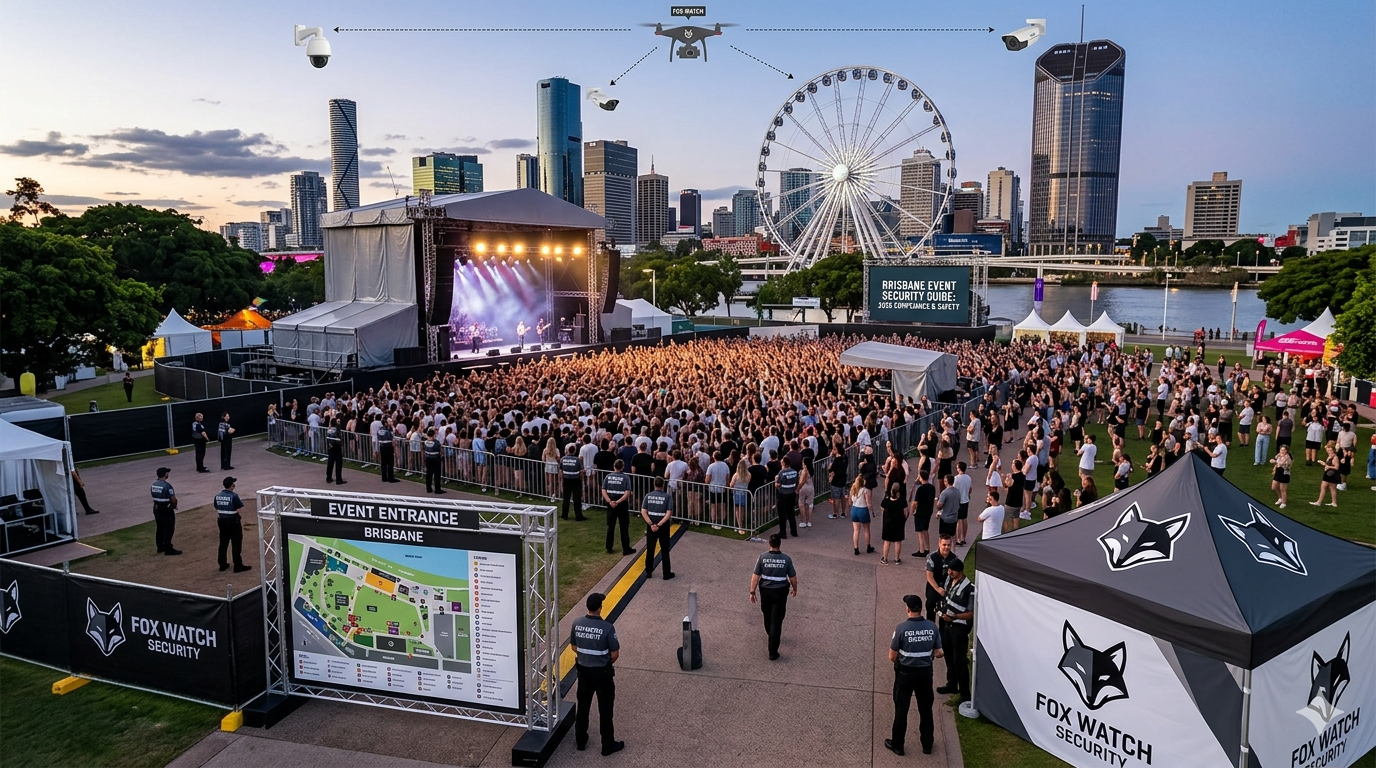
Brisbane Event Security Guide: 2026 Compliance & Safety
Let’s be honest — most event organisers think about Brisbane event security roughly three weeks too late.
You’ve locked the venue, confirmed the headline act, sorted the bar, and then someone in the planning meeting mentions security. Suddenly you’re scrambling to find a crew, realising you haven’t touched the permit application, and wondering whether your existing public liability policy actually covers what you think it does.
This guide is for anyone who wants to get ahead of that. Whether you’re organising a weekend festival at South Bank, a packed concert night in Fortitude Valley, or a large corporate event somewhere in between — here’s what compliance actually looks like in Brisbane in 2026, written plainly, without the bureaucratic fog.
Brisbane Event Security in 2026 — Why the Rules Have Tightened
Brisbane isn’t the same city it was five years ago. The events pipeline has exploded. More festivals, more international acts, more private hire of public spaces — and with that, Brisbane City Council and the Queensland Government have progressively closed off the grey areas that organisers used to quietly exploit.
The short version: Brisbane event security now lives inside three separate legal frameworks, and you need to satisfy all three before anyone opens a gate.
Those frameworks are:
1. Brisbane City Council’s Events Local Law 2022 2. The QLD Security Providers Act 1993 3. Queensland liquor licensing regulations (Liquor Act 1992 / Liquor Regulation 2002)
These don’t talk to each other automatically. You can be fully compliant with your Council permit and still be in breach of your liquor licence conditions because your security-to-patron ratio is wrong. Organisers learn this the hard way.
The Events Local Law — Your First Checkpoint
Brisbane City Council’s Events Local Law 2022 is what most organisers hit first. It’s the law that requires prescribed events on Council-managed land — parks, public spaces, South Bank — to hold a permit before they open to the public.
There are two types of events under this framework.
Self-Assessable Events
Self-assessable events are generally those expected to draw at least 2,000 attendees, provided they don’t involve loud outdoor music above 95 dBC at 15 metres from any speaker. You work through a compliance checklist yourself, certify that your event meets the requirements, and lodge the application. Council doesn’t assess it individually.
Straightforward enough. Until your event grows, adds a stage, or adds a bar — and suddenly tips into the other category.
Assessable Events and the Assessable Event Permit
The Assessable Event Permit is where things get serious. Council assesses these applications case-by-case, which means a real person is reading your documents and deciding whether your event is sufficiently planned to proceed.
These are the events that don’t fit the self-assessable mould — bigger crowds, higher-risk elements, alcohol service, late finishes, events near residential areas. If you’re running anything in Fortitude Valley past midnight or bringing thousands of people into a South Bank park for a ticketed festival, you’re almost certainly in assessable territory.
What you need to lodge an Assessable Event Permit application:
- A detailed site plan
- An Emergency Response and Evacuation Plan (non-negotiable — more on this below)
- A Certificate of Currency for Public Liability insurance — minimum $20 million, with Council named as an interested party if the event is on Council land
- A security management plan if alcohol is being served
- An alcohol management plan if alcohol is being served
- Payment of the relevant application fee
And you need to lodge it at least 30 working days before your event starts.
That last point catches people every single time. Thirty working days is six calendar weeks, roughly. Count it backwards from your event date the moment your venue is confirmed — not the week before.
The QLD Security Providers Act — Licensing Is Not Optional
Under the Security Providers Act 1993 (QLD), every person working as a crowd controller at a Brisbane event must hold a current, individual Queensland security licence. The security company itself must also hold a company-level licence.
This isn’t a technicality. If someone gets hurt at your event and your security staff turn out to be unlicensed, the liability exposure moves directly to you as the organiser. That’s not a scenario you want to be exploring after the fact.
What to actually verify before you hire event security guards in Brisbane:
Ask every company you’re considering for the licence numbers of the guards they intend to deploy. Then go and check those licences yourself through the Office of Fair Trading Queensland. It takes five minutes. Any company that won’t give you licence numbers upfront is telling you something.
Beyond licensing, look at experience. A guard with a valid QLD licence who has spent the last two years on retail loss prevention is not the same person as a guard who has worked crowd control services at Brisbane festivals and stadium events. The licence is the floor, not the ceiling.
FoxWatch Security deploys guards who are not only fully licensed under the QLD Security Providers Act but carry hands-on experience at Brisbane’s major event precincts — the kind of practical knowledge that only comes from actually working those environments.
Liquor Licensing Regulations QLD — The Layer Most People Miss
Here’s the one that trips up even experienced organisers: your event security obligations under Queensland’s liquor licensing regulations are entirely separate from your Council permit obligations. Holding a valid Assessable Event Permit does not mean you’ve satisfied your liquor licence requirements. They’re different documents, different authorities, different compliance checks.
Under the Liquor Regulation 2002, venues in the Brisbane City Council area that trade after 1 am must maintain mandatory security-to-patron ratios. Full stop. And from 11 pm on any night where the premises trades past 1 am, security providers are required to maintain surveillance in and around the licensed area — continuing for at least an hour after the premises closes (including the 30-minute grace period after official closing time).
If you’re running a late-night concert in Fortitude Valley and your crowd controllers finish at midnight, you’re in breach.
Alcohol Management Plan
For any assessable event in Brisbane where alcohol is served, Council requires both a security management plan and a separately articulated alcohol management plan. These aren’t the same document. Your alcohol management plan needs to address:
- How staff will identify intoxicated patrons before they become a problem
- Clear refusal-of-service procedures and how they’re communicated to bar staff
- Designated consumption zones and restricted areas
- How security and bar management communicate in real time
A weak alcohol management plan is the number one reason permit applications stall at Council review. Write it as if someone is going to test every procedure on the night — because if something goes wrong, they will be.
Your Emergency Response and Evacuation Plan
The Emergency Response and Evacuation Plan is mandatory for Assessable Event Permit applications in Brisbane. It’s also the document that most organisers treat as an admin task rather than an operational one — and that’s where things fall apart.
Your EREP isn’t just for Council. It’s what your crowd controllers and event staff work from when something actually goes wrong. A document that lives in a folder and never gets briefed to the team is not an EREP — it’s paperwork.
A properly built EREP covers:
Evacuation routes — mapped clearly, kept unobstructed throughout the event, and walked through by every security staff member before the gates open. Not just described in a document.
Assembly points — properly identified, large enough for your expected attendance, and signposted in a way people can actually find under stress.
Medical response — where are the first aid posts? How many personnel? What’s the handoff procedure for a serious medical incident? At what point does QLD Ambulance Service get called, and who makes that call?
The communication chain — who calls what, in what sequence, when an emergency is declared. Every crowd controller on your team should be able to answer this from memory.
Individual guard roles — during a normal event and during an evacuation, these are different things. Your EREP should specify both.
Brisbane City Council provides EREP templates as a starting point. Use them, but don’t stop there. A template built for a generic event doesn’t know your site’s bottlenecks, your crowd’s demographic, or where your venue’s actual risk points are.
Risk Assessment — Before the Hi-Vis Goes On
Brisbane event security planning starts with a risk assessment, well before anyone is deployed to site. This is the document that should be driving every other decision — how many crowd controllers you need, where they stand, what equipment they carry, what your triggers for escalation are.
A proper event risk assessment for a Brisbane event looks at:
The venue — where are the natural bottlenecks? Where do crowds naturally funnel? What happens at those points if something goes wrong?
The event profile — a family festival at South Bank on a Saturday afternoon carries a fundamentally different risk profile to a sold-out concert in Fortitude Valley at 11 pm on a Saturday night. Both need security. The planning looks completely different.
Weather — Brisbane’s subtropical climate means afternoon storms are a genuine operational risk for outdoor summer events. Your risk assessment should include weather monitoring protocols and clear triggers for shelter procedures or event suspension.
Historical data — has this venue had incidents before? What type? A good security company should know this going in, not discover it after.
QPS intelligence — for larger or higher-profile events at South Bank or in Fortitude Valley, early liaison with Queensland Police Service is standard practice. QPS may have relevant intelligence, and that conversation shapes your planning.
The risk assessment output feeds directly into your staffing model.
Crowd Control Services in Brisbane — Getting the Numbers Right
Under-staffing is by far the most common security error at Brisbane events. Organisers cut the crowd controller head count to save money and end up paying for it in other ways — incidents, Council permit conditions not met, liquor licence breaches, or simply a bad event that reflects on the brand.
There’s no universal ratio, but here’s a practical framework:
| Event Type | Rough Starting Guide |
| Community event, no alcohol | 1 crowd controller per 200–300 patrons |
| Licensed event, alcohol served | 1 crowd controller per 100–150 patrons |
| Late-night licensed, BCC area (post-1 am) | Per Liquor Regulation 2002 mandatory ratios |
| Multi-stage outdoor festival | Per-stage assessment plus perimeter, entry/exit, and roving patrols |
For Brisbane festival security hire specifically, the mix of roles matters as much as the total count. You need entry and exit controllers managing the gate, floor crowd controllers circulating through the audience, a designated incident controller who is your interface with event management and emergency services, and — for outdoor sites — perimeter patrols. Those are different roles. Putting the same person in all of them doesn’t work.
The FoxWatch Security events team builds staffing models from your specific site plan and risk assessment output, not a generic template. The number of crowd controllers you need at South Bank Parklands for 5,000 people is not the same as what you need for 5,000 people in a contained Fortitude Valley venue.
South Bank and Fortitude Valley — Brisbane’s Two Hardest Precincts
South Bank
South Bank Parklands events involve Council land, South Bank Corporation as a separate precinct manager, proximity to the river, heavy pedestrian traffic from the surrounding cultural precinct, and significant public transport usage at the start and finish. Planning security for an event here means accounting for crowd movement that extends well beyond your actual event footprint — people arriving, leaving, spilling into adjacent public areas.
You’ll generally need to coordinate with both Brisbane City Council and South Bank Corporation on your event application. Get started earlier than you think you need to.
Fortitude Valley
Fortitude Valley is Brisbane’s most complex security environment, full stop. Late-night trading, high alcohol consumption, a dense entertainment strip with multiple adjacent licensed venues, and a crowd demographic that skews young and energetic. The compliance requirements are real — BCC-area surveillance obligations kick in at 11 pm, Liquor Regulation 2002 ratios apply from 1 am — and the operational demands on crowd controllers are genuinely different to working a daytime family event.
If you’re hiring event security guards in Brisbane for a Fortitude Valley event, the company you choose should have specific, recent experience in that precinct. General event security experience isn’t the same thing. The Valley has its own rhythms and its own risk profile, and your crowd controllers need to know it from the inside.
What to Look for When Comparing Brisbane Concert Security Companies
The market for Brisbane concert security companies ranges from highly experienced, well-resourced operations to small teams that will take the booking and figure it out on the night. Here’s how to tell them apart before you sign anything.
Non-negotiables:
- Current QLD Security Providers Act licence — company and individual guard level
- Will provide individual guard licence numbers for your own verification
- Demonstrated experience at events of comparable scale and type
- Can contribute to or review your security management plan before Council submission
- Adequate public liability insurance — ask for the certificate
Signs of a quality operation:
- Conducts a full site visit before the event, not just a phone call
- Provides detailed staff briefings and site inductions before gates open
- All guards carry radio communication — not just the supervisor
- Has a post-event debrief and incident reporting process as standard
- Their EREP integration is operational, not just documentary
FoxWatch Security covers Brisbane’s event landscape from corporate events through to large outdoor festivals, with teams briefed specifically on the compliance requirements and on-the-ground realities of the precincts we work in.
Your Security Management Plan — What Council Actually Needs to See
For assessable events serving alcohol, the security management plan is a mandatory submission document. Council reads this. Here’s what needs to be in it:
- Security company details — company name, licence numbers, emergency contact
- Staffing plan — total guard numbers, individual roles, mapped positions on your site plan
- Patron entry procedures — ID checking policy, bag check procedure, prohibited items list
- Intoxication management — how intoxicated patrons are identified, refused entry, or removed safely
- Incident response procedures — escalation chain, when to call police, when to call ambulance
- Internal communications — how guards communicate with each other and with event management
- CCTV — camera coverage and monitoring arrangements if applicable
- Post-event crowd dispersal — how the venue is cleared safely after the event ends
A vague security management plan — one that describes things in general terms without specifics — will draw questions from Council and potentially delay your permit. Write it as an operational document, not a form you’re filling in to satisfy a requirement.
Patron Safety — What Compliance Doesn’t Cover
Getting your permit is one thing. Actually keeping people safe on the night is another. These two things overlap, but they’re not the same.
What separates events where patron safety genuinely holds up from events where it technically meets the standard:
Proactive crowd monitoring. Trained crowd controllers don’t wait for a problem to become visible — they’re reading crowd density, body language, and energy levels continuously. The goal is to identify a situation five minutes before it becomes an incident, not five seconds after.
First aid as part of the security plan. Your crowd controllers should know exactly where every first aid post is located and have a clear, practised protocol for medical handoffs. This doesn’t happen automatically. It happens because someone built it into the briefing.
Accessibility. Entry and exit planning needs to account for patrons with mobility requirements. Security staffing plans that ignore this create bottlenecks that are bad for everyone.
Weather contingency. Outdoor Brisbane events in summer face real storm risk. Your operational plan should include clear weather monitoring protocols and defined triggers for moving into shelter procedures or suspending the event. “We’ll deal with it if it happens” is not a plan.
A quiet space. For any large licensed event, having a designated low-stimulation area where unwell or overwhelmed patrons can be taken — away from the main crowd, close to first aid — is practical crowd management that also genuinely helps people.
Coordinating With Queensland Police Service
For larger or higher-risk Brisbane events, QPS coordination isn’t optional — it’s expected. Council will often ask what engagement you’ve had with QPS as part of the permit assessment process.
Proactive QPS liaison gives you access to any current intelligence that might affect your event planning, allows you to agree in advance on protocols for when your crowd controllers hand off to police, and means emergency response is coordinated rather than improvised.
This applies to mid-sized events too. A 3,000-person Fortitude Valley concert on a Friday night and a South Bank festival with multiple stages benefit significantly from having that pre-event conversation with QPS — even if police aren’t physically present throughout.
Where Brisbane Event Organisers Consistently Go Wrong
Five compliance failures that come up repeatedly, year after year:
1. Miscounting the application window. Thirty working days means six calendar weeks. People count calendar days, not working days, and end up short. Lock your event date, count backwards immediately.
2. Generic, copy-pasted plans. Council reviewers read a lot of security management plans. A document that clearly came from a template and hasn’t been adapted to the actual event gets questions — and sometimes gets sent back.
3. Unlicensed security staff. Using mates, bouncers-in-name-only, or casual workers without valid QLD security licences is both illegal and a direct personal liability for the event organiser. Check every licence number.
4. Treating the alcohol management plan as an afterthought. It gets written in 20 minutes the night before submission and it reads like it. This is one of the most scrutinised documents in the application for licensed events.
5. No post-event review. Most organisers do nothing with the security outcomes after an event. No debrief, no incident documentation, no lessons captured. Then they run the same event next year and wonder why the same problems recur.
How FoxWatch Security Works With Brisbane Event Organisers
At FoxWatch Security, the event work starts before anyone’s deployed to site. We work with Brisbane event organisers from the planning phase through to post-event review — not just the night itself.
What that looks like in practice:
- Risk assessment and staffing modelling before your permit application goes in
- Security management plan input — we can help you build or review the document to Council requirements
- Fully QLD-licensed crowd control teams with genuine experience across Brisbane’s major event precincts
- EREP integration — every guard on your event is operationally briefed on your emergency plan before gates open
- On-the-night incident control — a designated incident controller who is your single point of contact across the security team
- Post-event debrief and incident reporting — documented, not just a conversation
If you need Brisbane festival security hire, crowd control for a late-night Fortitude Valley concert, or a full event security package for a corporate function, we scope the team and the plan to what your specific event actually needs.
Get a quote for your event from FoxWatch or reach our Brisbane team directly to start the planning conversation.
2026 Brisbane Event Compliance Checklist
Use this before you lodge any permit application:
- [ ] Confirm whether your event is self-assessable or assessable under the Events Local Law 2022
- [ ] Application lodged at least 30 working days before the event start date
- [ ] Site plan prepared
- [ ] Emergency Response and Evacuation Plan completed — operationally, not just for submission
- [ ] Security management plan completed (required for licensed events)
- [ ] Alcohol management plan completed (if alcohol is served)
- [ ] Public Liability insurance obtained — minimum $20 million, Council named as interested party if on Council land
- [ ] Security company QLD licence verified
- [ ] Individual crowd controller licences verified
- [ ] Security-to-patron ratios confirmed against Liquor Regulation 2002 requirements (if applicable)
- [ ] QPS liaison completed for higher-risk or large-scale events
- [ ] Full security briefing scheduled before gates open on event day
- [ ] Post-event debrief and incident documentation arranged
Frequently Asked Questions
Q1. What is an Assessable Event Permit in Brisbane and when do I need one?
It’s required when your event doesn’t qualify as self-assessable under Brisbane’s Events Local Law 2022 typically events with higher risk, larger attendance, or alcohol service needing individual Council sign-off.
Q2. How many crowd controllers do I need for a Brisbane event?
Licensed events generally need 1 per 100–150 patrons as a baseline. Late-night BCC-area venues trading after 1 am must meet mandatory Liquor Regulation 2002 ratios — no flexibility there.
Q3. Do all Brisbane event security guards need a QLD licence?
Yes. Every individual working as a crowd controller must hold a current QLD licence under the Security Providers Act 1993. Verify licence numbers yourself via the Office of Fair Trading before hiring.
Q4. What goes into an Emergency Response and Evacuation Plan for a Brisbane event?
Evacuation routes, assembly points, first aid post locations, medical handoff procedures, communication chains, weather contingency triggers, and specific crowd controller roles during an emergency.
Q5. Are liquor licensing regulations QLD separate from the Council event permit?
Completely separate. Your Council permit and your liquor licence compliance run in parallel. You can hold a valid event permit and still breach your liquor conditions — organisers find this out the hard way.
Comments are closed