
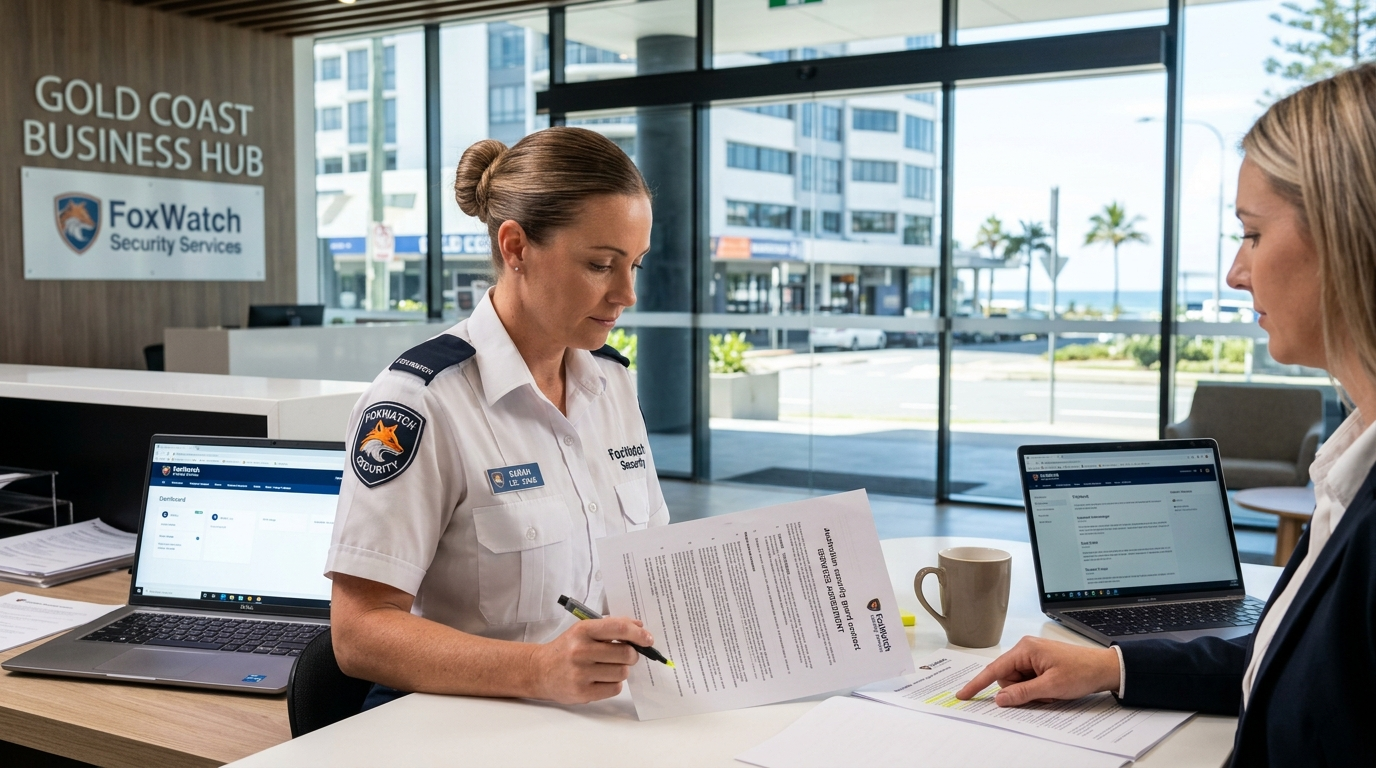
Australian Security Guard Contract Guide: What to Look for in 2026
The Australian Security Guard Contract Most Businesses Sign Without Reading
Let’s be honest about something. Most business owners on the Gold Coast — and across Australia — sign a security guard contract the same way they agree to app terms and conditions. They scroll, they skim, and they sign because they want guards on-site by Friday.
Then something goes wrong. A guard doesn’t show. An incident happens and there’s no written protocol for how it gets reported. The contract is pulled out and nobody can agree on what it actually says.
We’ve had clients come to us after exactly this experience. One retail manager in Broadbeach was paying for four nights of mobile patrol that the contract only technically committed to two. A warehouse operator in Coomera had no idea his provider had subcontracted the work to a different company entirely — one he’d never vetted.
An Australian security guard contract isn’t just paperwork. It’s the only thing protecting you when things don’t go to plan.
This guide is for anyone who’s currently shopping for a contract for security guard services in Australia, or reviewing an existing one. We’ve written it specifically for Queensland and Gold Coast conditions — the legislation, the market rates, the seasonal quirks that make this region different from Sydney or Melbourne.
What the Law Actually Requires in Queensland
Every security company contract Australia needs to sit within the legal framework — not around it.
In Queensland, the relevant piece of legislation is the Security Providers Act 1993 (Qld). Under this Act, any company providing contract security guards Australia must hold a current Security Firm licence issued by the Queensland Police Service. Individual guards need their own Security Officer licence. If your contract involves crowd controllers — at a venue, an event, or anywhere alcohol is served — those guards need a separate Crowd Controller licence on top of that.
This matters in practice. If an unlicensed guard is working on your site and something happens — an altercation, an injury, a theft — your insurance situation can get complicated very quickly. Some liability policies include exclusions for incidents involving unlicensed operatives.
Nationally, security licensing requirements differ between states. Victoria, NSW, and WA each have their own framework. But in Queensland, which covers the Gold Coast, the QPS is the issuing authority and the compliance benchmark is clear.
Before you sign anything, ask your prospective provider to show you their firm licence and confirm the licensing status of the specific guards being allocated to your site. Not guards in general — your guards. Any established private security provider will hand this over without blinking. If they hesitate, that tells you something.
FoxWatch Security holds all required Queensland licences and provides licence documentation as part of every client onboarding.
The Australian Security Guard Contract: 10 Things That Need to Be in It
Here’s what actually matters. Not what sounds impressive — what protects you when you need it to.
1. A Real Scope of Services
“Security services will be provided as required” is not a scope. We’ve seen that exact phrase — or something close to it — in contracts from providers operating across Queensland.
A proper security service scope in a security services contract Australia should tell you:
- Whether you’re getting static security guards, mobile patrol services, or both
- Exactly how many guards are on-site during each shift
- Whether alarm response security is included or charged separately
- Whether CCTV monitoring is live or recorded-only
- How access control security and visitor management are handled at entry points
- What happens during shift changeovers — who’s on-site, for how long, and who confirms handover
If crowd work is involved — a venue, a festival, a retail precinct — the contract needs to specify crowd control services separately, because those guards operate under a different licence class.
The more specific the scope, the harder it is for either party to argue about what was or wasn’t included.
2. Guard Licensing — Individually Confirmed
This comes up again here because it needs to be stated in the contract itself, not just verified verbally.
The agreement should require that all trained security officers deployed to your site hold current Queensland Security Officer licences. If Blue Cards are required — this applies to school security services and anywhere children are regularly present — that requirement should be written in too.
FoxWatch Security’s security guard team runs every guard through background checks, reference verification, and licence confirmation before they go on any site. It’s standard practice. It should be standard in your contract too.
3. Public Liability Insurance — with a Certificate
No certificate, no signature. That’s the rule.
Any legitimate security company contract Australia must specify the provider’s public liability insurance coverage. In 2026, the working standard for commercial security guard services Australia is a minimum of $20 million in coverage.
Ask for a Certificate of Currency dated within the last 12 months. “We’re fully insured” is not the same thing as showing you documentation. Without this, an incident on your premises could expose you to claims your own insurance might not cover cleanly.
FoxWatch Security provides current insurance documentation to every client before contracts are finalised.
4. Written Security Guard Duties — Not Vague Descriptions
“Patrol the premises and report issues” is not a duties clause. It means different things to different people and it will mean different things the moment something goes wrong.
The security guard duties in your contract should be specific enough that a new guard could read them and know exactly what’s expected:
- Patrol frequency — how often, which areas, what time
- Incident reporting procedures — who gets notified, when, and in what format
- Emergency response security protocols — who calls who, in what sequence
- Access control responsibilities — who is admitted, who is turned away, what documentation is required
- Communication procedures — how guards log their shifts and contact site management
If security guard responsibilities are ambiguous in writing, they’re deniable in practice.
5. A Guard Deployment and Roster Plan
Who specifically is coming to your site? How are replacements handled when a guard calls in sick at 5am on a Monday?
A solid security staffing agreement answers these questions before they become problems. It should include a guard deployment plan — meaning which guards are assigned to your site, what their standard hours are, and who the supervisor is. It should also state minimum notice periods for any staffing changes and how replacement guards are vetted.
Security roster management matters more on the Gold Coast than in most Australian cities because demand here is seasonal and uneven. During Schoolies in November, the Gold Coast Film Festival, New Year’s Eve on Surfers Paradise — staffing pressure on security companies spikes hard. Your contract should include provisions for surge periods, not just standard operating conditions.
6. A Site Security Plan — Documented Before Work Starts
This is separate from the contract itself but should be referenced in it and completed before the first shift starts.
A site security plan maps your actual property — entry and exit points, high-risk areas, blind spots in camera coverage, evacuation routes. It documents patrol routes for mobile patrol services, identifies who on-site has authority to direct guards, and establishes what level of threat triggers what response.
It also forms the basis of a proper security risk assessment. Without one, you’re paying for a general security presence rather than a tailored solution.
Don’t sign a commercial security contract Australia with a provider who hasn’t walked your site first. Physical familiarity with the location is basic. A company offering to put guards on your site without visiting it first is offering a service that hasn’t been thought through.
FoxWatch Security conducts site assessments across the Gold Coast before every new engagement.
7. Incident Reporting — Format, Timeline, Recipient
Every incident needs a paper trail. That paper trail is what protects you with insurers, with regulators, and if a matter ever goes to court.
Your contract should specify:
- What qualifies as a reportable incident (there should be a clear threshold, not just “serious” incidents)
- How long after an incident the report must be filed — 24 hours is the industry standard
- What format reports take — written, digital, photographic
- Who receives the report — site manager, property owner, or both
Good incident reporting is also how patterns get identified. If your site is seeing regular low-level incidents at the same time and place, that data should be informing your security risk assessment and changing your guard deployment. That only happens if incidents are being recorded properly from day one.
8. Contract Term, Exit Clauses, and Performance Reviews
Read this section of every contract twice.
Some security service agreement Australia documents include lock-in periods of 12 to 24 months with exit penalties structured in a way that makes leaving prohibitively expensive regardless of service quality. That’s not a partnership — it’s a trap.
A fair contract will include a termination clause (30 days written notice is the norm), a performance review schedule (quarterly is reasonable), and clear grounds for immediate termination if fundamental obligations are breached. “Fundamental obligations” should be defined — not left to interpretation.
If the contract doesn’t let you exit based on documented underperformance, walk away from it. Any private security contract Australia that doesn’t include accountability measures is written to protect the provider, not you.
9. Transparent Security Service Pricing
Security guard hourly rates on the Gold Coast in 2026 generally sit between $35 and $65 per hour, depending on the level of officer, the service type, and shift timing. Rates on public holidays, overnight, and for crowd controllers at licensed venues sit at the higher end.
The pricing section of your contract should break this down clearly:
- Standard hourly rate vs. overtime rate
- Weekend and public holiday loading
- Call-out fees for after-hours alarm response security
- Vehicle hire costs if mobile patrol services are involved
- Any annual price escalation clauses — often tied to minimum wage reviews
A security guard contract with a single bundled figure and no line-item breakdown is a red flag. You can’t manage a service you can’t measure, and you can’t measure what isn’t itemised.
10. Security Compliance — Referenced by Name
Security compliance Australia requirements should be named in the contract. This includes the Security Providers Act 1993 (Qld), relevant sections of the Work Health and Safety Act 2011 (Qld), and any industry codes applicable to your sector.
This matters because it creates a clear compliance baseline. If a guard behaves in a way that breaches these requirements, the contract gives you documented grounds to act.
What Kind of Security Contract Do You Actually Need?
Not everyone needs the same thing. Here’s how the main contract types break down.
Business Security Guard Contract
A business security guard contract covers commercial premises — offices, retail outlets, warehouses, hospitality venues, industrial sites. The core services are usually a combination of static security guards at entry points, CCTV monitoring, access control security, and visitor management.
For Gold Coast businesses in Southport, Robina, Varsity Lakes, or the CBD, a well-structured commercial security contract Australia is the practical baseline. Whether you’re running an office building security setup or protecting high-value inventory in a distribution centre, the contract needs to reflect your actual operating hours and risk profile — not a template built for someone else.
FoxWatch Security works with Gold Coast commercial clients across a range of industries and builds contracts around the actual site, not a standard package.
Security Guard Contract for Events
A security guard contract for event operates differently from a long-term service agreement. It’s time-bound, scope-specific, and the risk profile changes depending on the type of event.
For ticketed public events, the contract must include crowd control services, a crowd management plan, RSA-certified crowd controllers if alcohol is being served, and an emergency response security protocol. Post-event debrief and incident reporting should also be specified.
The Gold Coast runs a serious events calendar. Schoolies, the Gold Coast Marathon, film festivals, beachfront concerts, New Year’s on Cavill Avenue — these are large-scale, high-density events that carry real crowd management risk. A one-page event security quote is not a contract. Get the full document.
FoxWatch Security’s event protection team has managed crowd control and event security guards across the Gold Coast for years. The team knows these venues and the particular pressures that come with them.
Mobile Patrol Contract
A security patrol contract is the right fit for businesses that don’t need a permanent on-site guard but need consistent, visible coverage after hours. Think retail precincts, industrial estates, car yards, storage facilities.
The contract should specify patrol frequency (how many times per night), route coverage, GPS verification that patrols actually happened, and what action is taken when something is found.
Mobile patrol services cost significantly less than static guarding, but the contract needs to be just as detailed. Cheap patrol agreements with no route documentation are almost impossible to audit.
FoxWatch Security’s mobile patrol service covers the Gold Coast region with GPS-tracked patrols, real-time reporting, and after-hours alarm response built in.
Specialist Sector Contracts
Some environments need contracts that go further than a standard security service agreement Australia:
Hospital security guards — the contract must address patient interaction protocols, duress response procedures, and mental health incident handling. These aren’t optional additions — they’re core to operating safely in a healthcare setting.
School security services — Blue Card requirements must be written into the agreement. Guards need to understand child safety obligations, not just general security duties.
Retail security guards — loss prevention is a specialist function. The contract should distinguish between general deterrence and active loss prevention work. Guards operating undercover need to be clearly identified in the agreement and their operating parameters defined.
Construction site security — access control is the primary function here, but the contract also needs to address tool and materials theft, after-hours patrol coverage, and how contractors are cleared to enter the site.
Warehouse security guards — shift-change handover, inventory access protocols, and CCTV monitoring integration should all be specified.
Concierge security — this is a different type of role that combines front-of-house presentation with security awareness. The contract should specify uniform standards, communication expectations, and the balance between customer service and security function.
How the Gold Coast Security Market Has Shifted in 2026
The Gold Coast security market is not what it was three or four years ago. A few things have genuinely changed that affect what you should be asking for in an Australian security guard contract:
Digital reporting is now the standard. GPS-tracked patrols, digital incident logs, photo documentation — these aren’t premium add-ons anymore. Any security contractor Australia who still relies on handwritten patrol sheets is behind. Your contract should reference the reporting technology being used, not just promise “regular updates.”
Queensland compliance audits have increased. The QPS has been more active in auditing security firms over the past two years. Unlicensed operators have been caught out. Some clients have had their contracts disrupted mid-term. The practical lesson is that security compliance Australia needs to be verified, not assumed. Ask for current licence documentation and check the QPS register yourself if you have any doubt.
Subcontracting is more common. Some larger security firms win contracts and then subcontract the actual guard deployment to smaller operators. This isn’t automatically a problem, but you need to know if it’s happening. Your contract should state clearly whether the provider is permitted to subcontract work and, if so, what vetting standards apply to any subcontracted licensed security personnel.
Demand peaks are harder to predict. Between tourism surges, infrastructure projects, and the Gold Coast’s expanding events scene, the demand for 24/7 security services spikes at times that aren’t always predictable. Make sure your security staffing agreement includes a procedure for handling surge requests — and what additional costs apply.
Businesses are moving to outsourced security. Across Queensland, more businesses are choosing outsourced security services over internal security staff. The reasons are practical — lower overhead, no payroll complexity, access to a deeper pool of trained security officers. But the contract still needs to be solid. Outsourcing the function doesn’t outsource your responsibility for what happens on your premises.
How to Hire Security Guards in Australia: The Practical Process
If you’re at the point of actually going to market, here’s how to approach it without wasting time.
Start by writing down what you actually need — not what you think a security company wants to hear. List the sites, the hours, the specific risk concerns, and any industry-specific requirements. This becomes your brief.
Then ask any provider you’re considering to conduct a security risk assessment before they quote. A site walk and risk assessment tells you whether they understand your environment. It also gives them the information they need to quote accurately rather than pricing to win and adjusting scope later.
Get a security guard quote Australia from at least two providers. Compare line by line — not headline totals. The scope, inclusions, and contract terms matter more than the bottom-line figure.
When the contracts arrive, go through them clause by clause using the checklist at the end of this article. Don’t be rushed — a one-month delay to review properly beats a 12-month contract you regret. If a provider pushes back on giving you time to review, that’s worth noting.
Verify every licence claim independently. The QPS publishes a security industry licence register. Use it.
Before you sign, ask for two or three references from existing clients in a similar industry. Any established professional security services Australia provider will have these available.
FoxWatch Security offers a no-cost consultation and site walk for Gold Coast businesses before any contract discussion. It’s the right way to start.
Contract Red Flags Worth Knowing
A few specific things that should prompt you to pause:
A contract with no licensing clause. If the agreement doesn’t reference the Security Providers Act 1993 (Qld) or confirm security licensing requirements, the provider either doesn’t understand their legal obligations or is hoping you don’t.
Pricing that’s well below the market rate. Security guard hourly rates on the Gold Coast have a floor. Anything significantly below $32–$35 per hour for standard guard work is likely cutting something — guard experience, licensing compliance, or insurance coverage.
A scope that reads like a marketing brochure. Phrases like “premium protection” and “industry-leading security solutions” are not service descriptions. The scope should read like a work order, not an advertisement.
No site-specific planning before signing. If a company is willing to put guards on your site without walking it first, they’re offering a generic service. Generic security guard contract arrangements produce generic outcomes.
An exit clause that requires you to pay out the remainder of the contract term if service quality drops. That’s not performance accountability — it’s the removal of it.
Why Gold Coast Businesses Work With FoxWatch Security
FoxWatch Security is based at Office 2, 9 Bay Street, Southport — operating within the Gold Coast market, not just servicing it from a distance.
Every engagement starts with a physical site walk and a written security risk assessment. Every security guard contract we issue specifies guard duties, patrol schedules, incident reporting requirements, and escalation procedures in full. Every guard we deploy holds a current Queensland Security Officer licence, has passed a police check, and has been through our own internal vetting process.
Our services cover static security guards, mobile patrol services, alarm response security, event security guards for Gold Coast functions, retail security guards, corporate security services, concierge security, construction site security, hospital security guards, school security services, warehouse security guards, and crowd control services — all available under a single security service agreement Australia if that’s what your operation needs.
We carry full public liability insurance and provide the Certificate of Currency upfront, before any contract is signed.
The Gold Coast’s pace — the tourism, the events, the construction activity, the seasonal swings — requires a security contractor Australia who understands the local environment. We do, because we work in it every day.
If you’re looking at a new security services contract Australia, or you want to review what you currently have, reach out for a free consultation. There’s no obligation and we won’t pitch something you don’t need.
Contact FoxWatch Security or call 0402 598 548 to arrange a security guard quote Australia for your site.
Security Contract Checklist
Before signing any Australian security guard contract, work through this list:
- [ ] Provider’s Queensland Security Firm licence number confirmed and verified on QPS register
- [ ] Individual guard licences confirmed for assigned staff
- [ ] Certificate of Currency for public liability insurance (minimum $20M) provided
- [ ] Service scope is specific — service types, guard numbers, shift hours, patrol frequency all stated
- [ ] Guard deployment plan included for your specific site
- [ ] Site security plan completed and referenced in the contract
- [ ] Security risk assessment conducted before signing
- [ ] Incident reporting procedures defined — format, timeline, recipient
- [ ] Security roster management procedures stated, including sick-leave and surge cover
- [ ] Emergency response security plan documented
- [ ] Termination clause present — 30 days written notice as standard
- [ ] Performance review schedule included
- [ ] Pricing is itemised — standard rate, overtime, public holiday loading, call-out fees
- [ ] Subcontracting provisions (permitted or prohibited) clearly stated
- [ ] Security compliance Australia requirements referenced by Act name
Frequently Asked Questions
Q1: What should an Australian security guard contract include?
It must cover licensed guard details, scope of services, public liability insurance, incident reporting, pricing, roster management, and a site security plan.
Q2: How do I verify a security guard’s licence in Queensland?
Check the Queensland Police Service licence register online or ask your provider for each guard’s individual Queensland Security Officer licence number before work begins.
Q3: What are typical security guard hourly rates on the Gold Coast in 2026?
Standard guard rates sit between $35–$65/hr. Rates vary based on officer level, shift timing, public holidays, and whether crowd controller licensing is required.
Q4: Can I exit a security guard contract early in Australia?
Yes, provided the contract includes an exit clause. Most reputable providers allow 30 days written notice. Check termination terms carefully before signing any agreement.
Q5: Does FoxWatch Security operate 24/7 across the Gold Coast?
Yes. FoxWatch provides round-the-clock static guarding, mobile patrols, alarm response, and event security across the Gold Coast seven days a week, year-round.
FoxWatch Security | Office 2, No 9 Bay Street, Southport QLD 4215 | foxwatchsecurity.com.au | 0402 598 548 | [email protected]
Comments are closed